
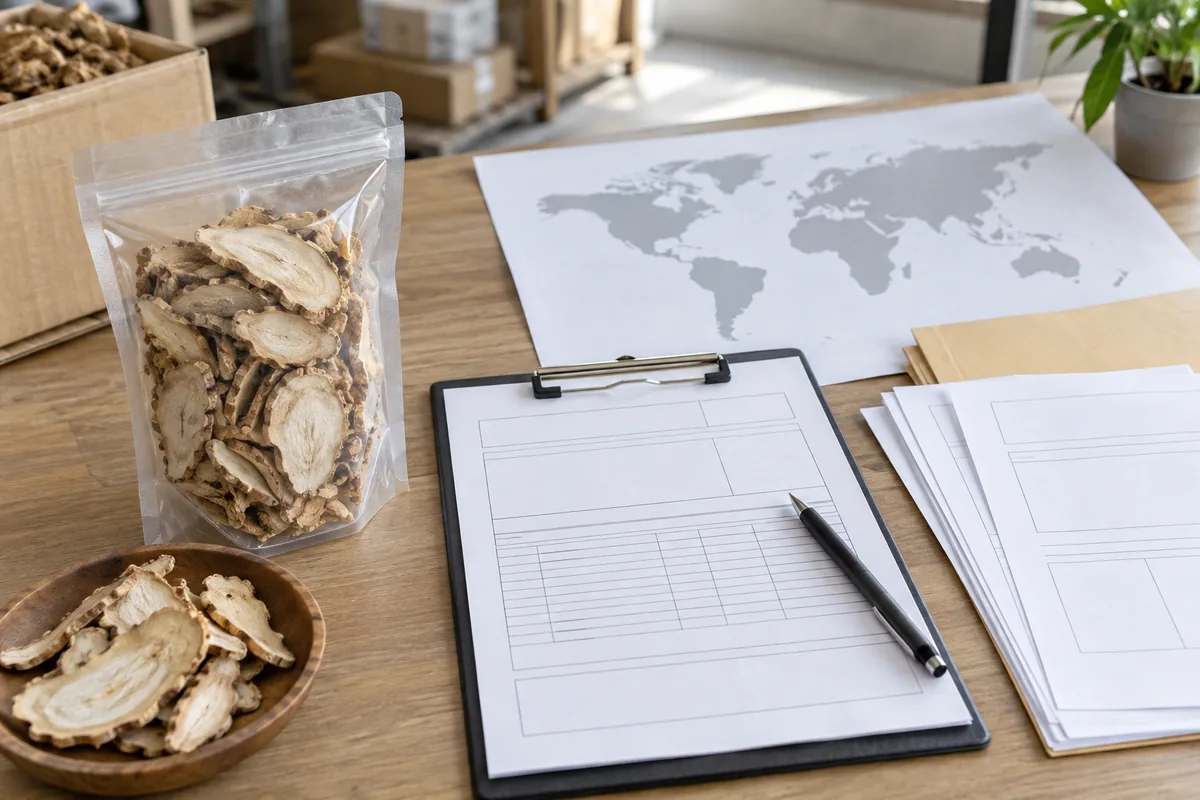
Import documentation for dried galangal is not one universal packet. The required set depends on the product description, botanical identity, intended use, treatment, packing, origin, destination, importer, current law, and any customer program. A document can also require action before loading, so checking after the cargo departs is too late.
The safest workflow starts with the importer or appointed customs broker. They confirm the current destination requirement. The buyer and exporter then turn each requirement into an owner, source, deadline, data field, and release check. This approach avoids both missing documents and unnecessary certificates that add cost without solving a requirement.
This article is a planning checklist for dried Alpinia galanga from Indonesia. It is not customs, legal, food-safety, tax, or plant-health advice. Official requirements change, and the competent authority or qualified professional must confirm the final set for the actual shipment.
Begin with the exact item being imported. The dried galangal products page separates slices from whole and chunk material. Keep that product identity connected to the complete B2B buyer’s guide, the packing and storage plan, and the quotation basis from the first brief through release.
1. Confirm the Product Description First
Documents cannot be correct if the product identity is vague. State dried Alpinia galanga rhizome, slices or whole and chunk format, Indonesia origin, bulk food ingredient or other intended use, pack type, net weight, and any treatment. The exact customs description and tariff classification should be confirmed by the importer or broker.
Do not copy an HS code from another supplier without review. Similar spices, fresh products, dried products, powders, extracts, or medicinal preparations can be classified differently. Classification affects duties, permits, restrictions, statistical reporting, and the authorities involved.
The product name should remain consistent across the invoice, packing list, bill of lading or air waybill, origin document, plant-health document, test report, and labels. If one document says galangal root, another says ginger, and another says botanical slices, the shipment can attract questions even when the material is correct.
Create one approved master-description line and share it with the exporter, broker, forwarder, laboratory, inspection company, and document issuer. Changes should be reviewed before documents are finalized.
2. Build a Destination Requirement Matrix
List every expected document in a simple table with columns for requirement, legal or customer source, responsible party, issuer, input data, application date, draft review, original or electronic form, shipment deadline, and final status. This matrix becomes the document plan.
Separate legal requirements from buyer preferences. A commercial invoice may be legally necessary, while a custom packing declaration may be a customer requirement. Both can be important, but the consequence and approval route differ.
Identify conditional requirements. A phytosanitary certificate may depend on plant-product rules and product condition. A treatment certificate depends on whether treatment is required and performed. Preferential origin depends on the applicable trade arrangement and qualification. A health certificate or official analysis may apply only to particular products, origins, or control measures.
Add a verification date and source link. Rules can change between product development and shipment. Reconfirm before commercial commitment and again before dispatch if the schedule is long.
3. Prepare the Commercial Invoice
The commercial invoice generally identifies seller, buyer, invoice number and date, product description, quantity, unit, unit price, total value, currency, Incoterm and named place, origin, payment terms, and other required transaction data. The importer and broker should approve the needed format.
Match the invoice to the quotation, purchase order, packing list, and transport booking. Use the agreed legal company names and addresses. Confirm whether the transaction involves an importer of record, consignee, notify party, agent, or different paying party and how each appears.
Avoid unsupported values or descriptions. Sample, free-of-charge, replacement, or non-commercial shipments can still require a declared value and import formalities. Ask the broker how to document the actual transaction.
Control the final revision. A late change to quantity, vessel, price, pack count, or consignee can make the invoice inconsistent with other documents. Record who reviews and releases the final version.
4. Prepare the Packing List
The packing list describes how the cargo is physically organized. Include product, format, lot or batch, number and type of packs, net weight, gross weight, dimensions where required, pallet count, marks, container or booking reference where known, and totals.
If several lots or formats share a shipment, map them clearly by pack or pallet range. A packing list that combines all dried galangal into one line can weaken receiving and traceability. The buyer should be able to locate a lot without unloading and opening every unit.
Weights should reconcile with the invoice, labels, and transport record. Gross weight includes packaging and pallets where applicable; net weight represents product. Confirm unit conventions and decimal formatting to prevent simple interpretation errors.
Use the actual final pack count. A draft based on the production plan should be marked draft. Replace it after packing and weight reconciliation.
5. Coordinate the Transport Document
Ocean shipments generally use a bill of lading, while air shipments use an air waybill. Other transport modes and combined routes use appropriate documents. The freight forwarder or carrier prepares the transport document from shipping instructions supplied by the responsible party.
Review shipper, consignee, notify party, cargo description, packages, weights, ports, dates, freight terms, and document type. Decide whether original, express release, sea waybill, or another release method is appropriate. That decision affects payment and cargo release.
The transport description should align with customs and commercial documents without adding a claim that the carrier cannot verify. Shipping marks and container or seal references should match the actual load record.
Meet the carrier’s draft-approval deadline. Changes after issuance can cause fees, delay, or mismatch with bank and customs documents.
6. Verify Origin Documentation
A certificate or declaration of origin may be required for customs, buyer policy, or a preferential tariff claim. The correct form, issuer, qualification rule, and supporting evidence depend on destination and applicable trade arrangement.
Indonesia origin should be supported by the actual sourcing and processing record. Origin is not established only by the exporter’s address. The responsible issuing or customs framework determines the rule.
If the buyer seeks preferential treatment, confirm eligibility before pricing assumes a duty benefit. Product classification, origin rule, direct-consignment condition, approved exporter status, or documentary format can affect the result.
Check names, product description, quantities, invoice reference, transport details, and dates. A small inconsistency can invalidate or delay a claim. The broker should review the draft when practical.
7. Check Plant-Health and Phytosanitary Requirements
Dried galangal is a plant-derived product, but phytosanitary requirements depend on the destination, product condition, processing, intended use, and current plant-health rules. The importer or plant-health authority should confirm whether a phytosanitary certificate, import permit, treatment, inspection, declaration, or no certificate applies.
Do not assume that dried or processed status automatically removes every plant-health requirement. Do not assume that a certificate is always needed either. Verify the exact commodity description and treatment state.
Where a phytosanitary certificate is required, the application may involve official inspection, treatment information, additional declarations, permit references, and a shipment window. Build this time into the production and booking schedule.
Keep the official product name, quantity, origin, consignee, transport, and marks consistent. Confirm whether the destination requires an original, electronic certificate, or specific system.
8. Define Food-Safety and Laboratory Evidence
Buyers may require a certificate of analysis, laboratory reports, conformity statement, product specification, allergen statement, treatment declaration, traceability information, or supplier approval documents. Legal import controls can also require specific certificates or analyses for selected products and origins.
The laboratory plan should name analytes, methods, limits, reporting units, sample identity, lot, laboratory, and deadline. A generic certificate with unrelated tests does not prove compliance with the buyer’s requirement.
Connect the report to representative sampling. State who samples, which lot is represented, how the sample is sealed, and how it reaches the laboratory. Review names and lot codes before release.
The food safety and quality control article explains why a test report must sit inside a wider control system. The specification guide helps define the required limits and methods.
9. Verify Treatment, Fumigation, and Packing Declarations
If the product or wood packaging receives a treatment, record the approved method, provider, date, lot or unit, parameters, and certificate or declaration required. The treatment must be allowed for the product, buyer, and destination.
Do not request fumigation by habit. A treatment can create residue, safety, sensory, occupational, legal, and documentation considerations. The importer and technical teams should identify the actual requirement and permitted options.
Wood pallets and dunnage can be subject to ISPM 15 when applicable. Confirm marking and material with the logistics provider and destination authority. The product’s phytosanitary status and the packaging’s wood-treatment status are separate questions.
Food-contact packaging declarations may also be required by buyer policy or law. Confirm the material, supplier, use condition, and evidence needed. A broad “food grade” statement may not answer a detailed buyer requirement.
10. Understand United States Import Planning
The United States Food and Drug Administration states that it must receive prior notice before food is offered for import, subject to the applicable rule and exemptions. Filing timing and data depend on the shipment and transport mode. The importer, broker, or filer should manage the current requirement.
Covered importers may also have responsibilities under the Foreign Supplier Verification Programs rule. FDA explains that the program is intended to verify that foreign suppliers produce food in a manner that meets applicable United States requirements and that the food is not adulterated or misbranded with respect to allergen labeling.
Food-facility registration, labeling, admissibility, entry data, and other requirements can also be relevant. Do not treat prior notice or FSVP as the entire import system. The responsible United States importer should identify the applicable parties and exemptions.
Use current FDA pages and a qualified customs or regulatory professional. Website summaries and old checklists can become outdated. Record the confirmation date in the shipment file.
11. Understand European Union Import Planning
The European Union uses official controls to verify compliance with agri-food chain law for both EU-produced and imported goods. Controls can include documentary, identity, and physical checks. Certain non-animal foods from specified origins can receive increased controls under current risk-based measures.
Pesticide maximum residue levels and contaminant rules can affect the product specification and laboratory panel. The European Commission maintains official tools and regulations, but the buyer must confirm the commodity category, current limits, origin measures, and competent authority process.
Member State implementation, entry point, customs procedure, plant-health status, food use, organic status, and customer requirements can influence the document set. “EU documents” is not a sufficient instruction.
The importer and broker should review the current European Commission and national competent-authority sources before the supplier quotes tests or certificates. If a rule changes, update the specification and document matrix together.
12. Control Drafts and Shared Data
Create a shipment master-data sheet with seller, buyer, consignee, notify party, product description, botanical name, format, origin, lot, quantities, weights, packs, marks, invoice, purchase order, Incoterm, ports, vessel or flight, container, seal, and dates.
Every document owner should use this controlled source. Highlight fields that remain provisional. Freeze the data at an agreed point and use a change log after that point.
Review drafts side by side. Automated text comparison can find spelling and number differences, while a qualified reviewer checks regulatory meaning. Pay attention to names, addresses, units, decimal separators, dates, and transposed lot numbers.
Do not send conflicting final versions through several message channels. Store the approved set in one controlled location and identify who transmits originals or electronic records.
13. Complete a Pre-Release Document Check
Before cargo release, confirm that every required document is present, approved, internally consistent, valid for the shipment date, and in the required form. Confirm that any official inspection or test has been completed and that the result applies to the loaded lot.
Match the physical cargo to the file. Product, format, packs, labels, lot, weights, pallets, container, and seal should agree with the records. A complete document packet for the wrong lot is not a successful release.
Assign open items. If a carrier document will be issued after departure, confirm the draft and process. If an original will travel by courier, record tracking and contingency. If an electronic system is used, confirm submission and acceptance status.
The shipping decision should follow the documented release sequence. Commercial pressure should not turn a missing legal or safety document into an assumption.
Import Document Checklist
- Approved product description, botanical name, format, origin, intended use, and classification review.
- Destination requirement matrix with sources, owners, issuers, deadlines, and verification dates.
- Commercial invoice with correct transaction, values, Incoterm, and parties.
- Final packing list with lot, pack, pallet, net, and gross weight reconciliation.
- Approved shipping instructions and transport-document draft.
- Certificate or declaration of origin where required.
- Import permit, phytosanitary certificate, inspection, or plant-health declaration where applicable.
- Specification, sample approval, certificate of analysis, and laboratory reports required for the lot.
- Treatment, fumigation, irradiation, steam, or other declarations only where applicable and approved.
- Food-contact packaging and wood-packaging evidence where required.
- United States prior notice and importer verification planning when the destination is the United States.
- European Union residue, contaminant, plant-health, and official-control review when the destination is in the EU.
- Buyer-specific statements, labels, translations, or bank documents.
- Final cross-document review against physical cargo and shipment master data.
Frequently Asked Questions
Does every dried galangal shipment need a phytosanitary certificate?
Not necessarily. The requirement depends on destination plant-health rules, commodity description, product condition, treatment, and intended use. The importer, broker, or competent authority must confirm the current requirement for the actual shipment.
Is a certificate of analysis an import document?
It can be required by a buyer, authority, risk-based control, or commercial agreement. It does not replace commercial, transport, origin, or official documents. The report must identify the sample and lot and match the approved specification.
Who files FDA prior notice for a United States shipment?
FDA allows prior notice through applicable filing systems, and different parties may act as filer. The importer and broker should assign responsibility and confirm timing and data. PT Tri Global Export should receive the final instruction early enough to supply correct shipment information.
Can the exporter choose the HS code?
The exporter can provide product information and a proposed code, but the importer or customs professional should confirm classification under the destination system. Do not rely only on a code from a website or earlier unrelated shipment.
How can I request a document plan from PT Tri Global Export?
Use the contact page and provide the product format, use, volume, destination country, port, importer or broker contact, Incoterm, and known requirements. The available document scope and responsibilities will be confirmed in writing.
Sources and Verification
- FDA: Importing Human Foods and FDA: Prior Notice of Imported Foods for United States import planning.
- FDA FSVP final rule overview for covered importer verification responsibilities.
- European Commission: Official Controls and Enforcement and EU Pesticides Database for current EU control references.
- Codex CXC 42-1995 for hygienic practice for spices and dried aromatic herbs.
This checklist is educational and is not legal, customs, tax, plant-health, or regulatory advice. Confirm current requirements with the importer, broker, competent authorities, and qualified advisers before quotation and shipment.
Prepared for buyer education. Product, test, document, availability, price, and destination requirements remain subject to written verification for the relevant order and lot.