
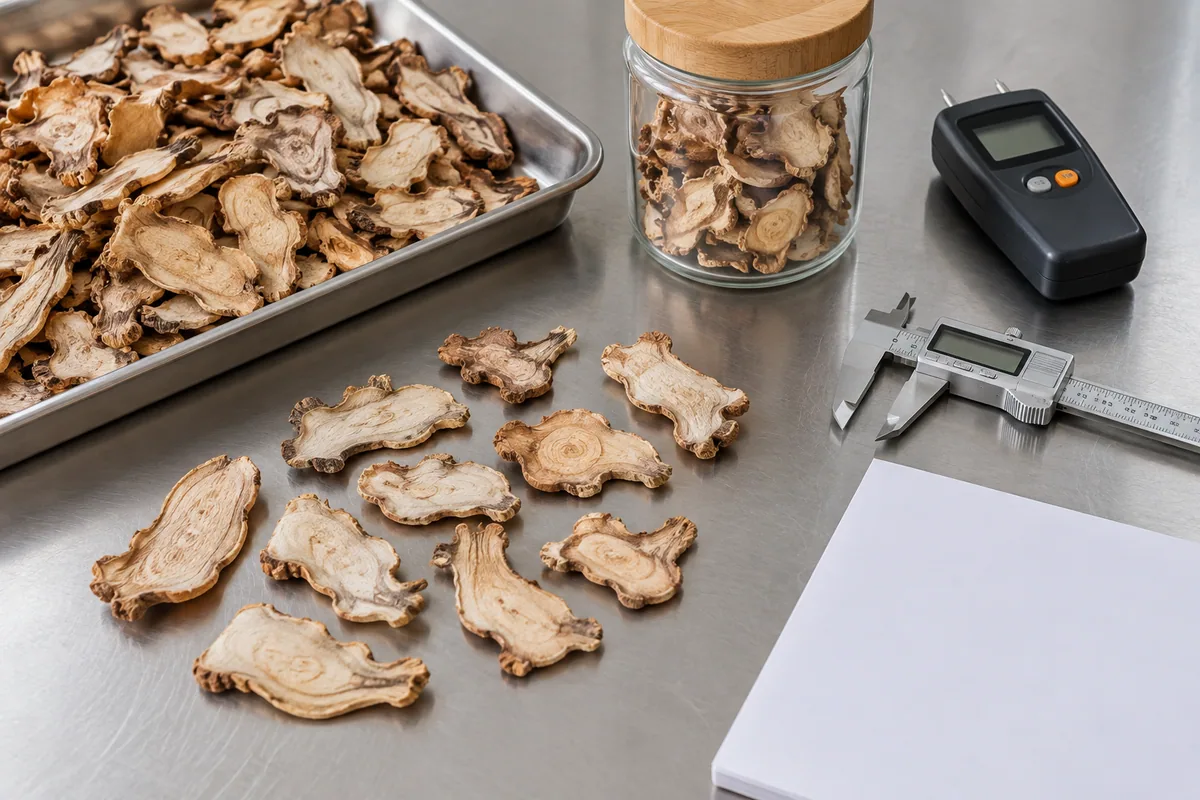
A dried galangal specification is the shared definition of what the buyer intends to receive. It should tell the supplier what to produce or allocate, tell the inspector what to check, tell the laboratory what to measure, and tell both parties what happens when a result is outside the agreed limit. If any of those readers must guess, the document is not finished.
The strongest specifications are not the longest. They focus on characteristics that affect botanical identity, legal compliance, food safety, process performance, yield, packing, and presentation. They also separate buyer requirements from supplier targets and actual lot results. This separation prevents a proposed value from being mistaken for a guarantee.
This guide explains how to write a buyer-ready specification for dried Alpinia galanga slices or whole and chunk material. It offers a framework, not a universal grade. Final limits and methods must match the product, application, destination, and current order.
1. Give the Document a Clear Identity
Start with document control. Add a title, document number, revision, issue date, product name, format, intended use, buyer, supplier, and approval status. If the document is a draft, mark it as a draft. If it is a target for discussion, do not present it as a current-lot certificate.
Document control sounds administrative, but it prevents practical errors. A purchasing team may attach an old specification to a new order. A supplier may quote against a draft while quality assurance expects the approved revision. A laboratory may receive only a parameter list without the sample code. One controlled reference keeps the commercial and technical files aligned.
State which document takes priority if the purchase order, specification, sample approval, and quotation conflict. A simple rule can require written resolution before production or allocation. Do not rely on the newest email being understood as the final instruction.
List the names or functions authorized to approve changes. A sales contact should not silently change a food-safety limit, and a laboratory result should not change the commercial tolerance. Controlled change is part of specification quality.
2. Write the Botanical and Product Description
The identity block should name Alpinia galanga (L.) Willd. when greater galangal is required. Kew lists this name as accepted. Include the plant part as rhizome, the dried condition, origin if required, and the commercial format. A clear line might state “Dried Alpinia galanga rhizome slices, Indonesia origin, for further food manufacturing.”
Avoid relying only on terms such as galangal root, Siamese ginger, or lengkuas. Common names vary between markets and can overlap with other plants. They can be included as additional names, but the botanical identity should remain primary in a B2B technical file.
State whether skin is retained, whether peeling or trimming is required, and whether additives or treatments are permitted. If the product must be a single ingredient with no added carrier or preservative, write that requirement. If a treatment may be used, identify the approval, declaration, residue, and document needs.
The product description should match labeling, invoice, packing list, certificate, laboratory request, and receiving record. Differences in naming across documents can create customs, traceability, and internal-release questions even when the physical material is correct.
3. Define the Format and Size Distribution
For slices, record cut direction where relevant, target thickness, acceptable range, proportion within range, diameter treatment, broken-piece definition, and fines limit. Natural rhizomes are irregular, so a distribution is usually more practical than a promise that every slice has one thickness.
For whole and chunk material, define piece categories. Use dimensions, weight ranges, representative photographs, an approved sample, or a combined method. State how smaller broken material is measured and whether it is accepted, limited, reworked, or excluded.
The inspection method must fit the geometry. Calipers can support slice thickness checks. Sieves can separate smaller size fractions when the openings and procedure are suitable. Large irregular pieces may need a visual and dimensional classification. The method should state sample mass or piece count and how results are calculated.
Include the point of inspection. A pre-shipment cut result can change through handling and transport. If the receiving condition is contractual, define the packing and transit assumptions and the receiving sampling method. If only pre-shipment condition is controlled, say so clearly.
The slices versus whole and chunk comparison helps the buyer choose the format before filling this section.
4. Replace Appearance Adjectives With References
Appearance requirements may include color, exterior condition, cut-face condition, visible mold, scorching, decay, shriveling, and other defects relevant to the application. Words such as natural brown, clean, or typical can begin a discussion, but they need an approved reference or defect definition for consistent inspection.
Use photographs carefully. Create them under stated lighting and include a reference code and date. Screens and cameras change color. A physical retained sample can support review, but it also changes with time and storage. Record which attributes the reference controls and which remain governed by written limits.
Define defect categories with examples. A buyer and supplier may disagree about whether a dark piece is normal skin color, drying variation, scorching, or decay. A defect library does not need to be elaborate. A few agreed photographs with names and acceptance rules can remove large areas of ambiguity.
Odor and aroma should also be described. State “characteristic of dried Alpinia galanga, free from objectionable foreign odor” if that matches the buyer’s review. If sensory intensity matters, use an agreed sample and controlled comparison method. Do not turn poetic aroma language into a pass/fail rule without a reference.
5. Define Foreign Matter, Extraneous Matter, and Infestation
The term foreign matter can cover very different things. A useful specification identifies relevant categories such as soil, stones, metal, glass, plastic, sack fiber, insects, animal contamination, other plant material, and unintended parts of the same plant. Risk and decision rules may differ between categories.
Some buyers distinguish extraneous matter from foreign matter. If those terms are used, define them in the document. Do not assume that an ISO method, national standard, supplier form, and buyer form use identical definitions. The acceptance calculation must use the same category names as the inspection.
State sample size, separation method, equipment, reporting unit, and maximum limit where a numerical rule is appropriate. High-risk physical hazards may require zero detection in the examined sample and an investigation rule rather than a simple percentage. The hazard analysis should determine the control.
Infestation criteria should distinguish live insects, dead insects, webbing, larvae, eggs where relevant, and evidence of activity. State the action if any sign is found. Treatment options, if allowed, must comply with the buyer’s policy and destination rules and should be approved before use.
6. Set Moisture and Stability-Related Requirements
Moisture content is a common dried galangal parameter. It affects paid weight, comparison between lots, handling, and storage behavior. The specification should state the maximum or range, method, units, sample preparation, and point of compliance. A moisture number copied from another spice is not automatically suitable.
Method matters because different procedures can produce different results. Record the agreed reference and whether a rapid instrument is used only for process monitoring or for contractual release. If the supplier and buyer use different methods, perform a comparison before a dispute occurs.
Water activity may be required when the buyer’s hazard analysis uses it. Water activity and moisture content are related but not interchangeable. One describes the amount of water under a method; the other addresses the availability of water in a different way. State the instrument, temperature, calibration, and limit if water activity is included.
Storage and packing belong beside these numbers. A release result can change if a liner is left open or a pack encounters condensation. Define the protective pack and storage condition that make the requirement meaningful. The packing and storage guide explains these connections.
7. Select Chemical and Compositional Parameters
Ash and acid-insoluble ash can support evaluation of total mineral residue and soil-related contamination under agreed methods. Volatile oil may be relevant for flavor or extraction applications. Pesticide residues, heavy metals, mycotoxins, and other contaminants may be required by destination law, customer policy, or the product hazard assessment.
Do not add every possible test to every order. A broad panel can be expensive and still miss the requirement that matters. Start with the intended use, origin, process, buyer standard, and destination rules. Identify each analyte or group, limit, method, laboratory requirement, sample frequency, and decision rule.
For pesticide residues, “complies with EU” is not a complete laboratory instruction. The applicable commodity classification, current maximum residue levels, scope of active substances, reporting limits, and sampling need review. The European Commission maintains an official pesticide database, but the importer should confirm how the product is classified and which current rules apply.
If volatile oil is specified, state the method and reporting basis. A target range discussed during development is not the same as a guaranteed minimum on every lot. The quotation should identify which requirement is included and how it will be verified.
8. Build the Microbiological and Food-Safety Section
Dried spices can carry microbiological hazards even when the product appears dry. The required criteria depend on use, process, whether a later validated kill step exists, destination law, customer policy, and the buyer’s hazard analysis. Common panels from other products should not be copied without review.
For each organism or indicator, state the sampling plan, method, units, limit, and decision rule. A statement such as “Salmonella absent” needs a test portion and method. Results such as colony-forming units need the reporting basis and handling of values below detection or quantification.
Clarify whether a treatment is required, prohibited, or optional with buyer approval. If steam or another microbial-reduction step is used, define process disclosure, post-process protection, validation or verification evidence, sensory acceptance, and labeling or documentation requirements. Do not imply treatment merely because the buyer requests a low result.
Connect test frequency to lot definition and risk. A certificate for one lot does not automatically represent the next. The food safety and quality control guide describes sampling, laboratory evidence, and release in context.
9. Specify Sampling, Testing, and Decision Rules
Sampling is often the weakest part of a detailed specification. Name the lot, number of units, selection approach, increment size, combined sample, laboratory portion, retained portion, and responsible party. Consider segregation of fines and different piece sizes inside packs.
State who may witness or appoint sampling, which laboratory is acceptable, and how chain of custody is recorded. If an external laboratory is required, confirm method capability and reporting time before setting the shipment schedule.
Define pass, hold, retest, rework, concession, downgrade, and rejection paths. Retesting should not become repeated testing until a passing number appears. State when retesting is justified, whether the original and retest results are both reported, and who authorizes the final decision.
Include rounding and measurement uncertainty where they affect a limit. A result near the boundary can create disagreement if one party rounds differently. The technical teams should agree on interpretation before the first lot is tested.
10. Write Packing, Labeling, and Net-Weight Requirements
Describe the inner food-contact liner, liner closure, outer bag or carton, outer closure, net weight, tolerance, pallet, stretch wrap, and any handling restriction. If the buyer requires material declarations or specific pack dimensions, include them before quotation.
List every label field and its exact source. Fields may include product name, botanical name, format, net weight, lot code, origin, production or packing date, best-before information where supported and required, supplier identity, buyer code, and storage instruction. Destination and customer rules determine the final list.
Use one data set across labels and documents. Product name, lot, quantity, weight, origin, and dates should agree with the invoice, packing list, test report, and certificates. A mismatch can delay internal release or customs review even when it is a typing error.
Define how damaged, open, wet, or incorrectly marked packs are handled. Receiving teams need a rule they can apply without waiting for a new interpretation.
11. Connect the Specification to Commercial Terms
The specification affects price, availability, yield, testing cost, packing cost, and lead time. The quotation should reference the specification revision. If a technical requirement changes, the supplier should confirm the commercial effect before the buyer issues or amends the purchase order.
Do not hide open points. Use a status column such as required, proposed, to be confirmed, or not applicable. A clearly open item is safer than an empty cell that each party interprets differently.
Identify the sample or lot basis of the quotation. A supplier may quote a production target while current material is still being prepared. Another supplier may quote an identified available lot. These offers have different availability risks even if the specifications look similar.
The bulk dried galangal quotation guide shows how to compare offers after the technical basis is aligned.
A Practical Specification Checklist
Before approval, confirm that the document includes:
- Controlled title, number, revision, date, status, and authorized approvers.
- Botanical name, plant part, origin requirement, dried condition, and intended use.
- Slices or whole and chunk format with a measurable size definition.
- Appearance, odor, defect, and reference-sample rules.
- Defined foreign-matter and infestation categories with methods and limits.
- Moisture and any water-activity requirement with method and sample preparation.
- Relevant compositional, contaminant, residue, and microbiological criteria.
- Sampling plan, laboratory requirement, units, reporting, and chain of custody.
- Clear pass, hold, retest, rework, concession, downgrade, and reject rules.
- Inner pack, outer pack, closure, net weight, pallet, label, and storage requirements.
- Required commercial, transport, origin, test, and destination documents.
- A statement connecting the approved sample, current lot, inspection, and release.
The document should be readable by someone who did not join the original sales conversation. That is a useful final test. If a new inspector can apply the requirement consistently, the specification is doing its job.
Frequently Asked Questions
Is there one international standard for dried galangal?
General standards and methods exist for spices, hygiene, sampling, moisture, ash, foreign matter, and volatile oil, but a buyer should not assume that one universal product grade covers dried galangal for every use and destination. Build the order specification from applicable rules and the buyer’s process.
Can an approved sample replace numerical limits?
An approved sample can control visual or sensory attributes that are difficult to describe. It should not replace measurable safety, legal, weight, moisture, or contaminant requirements. State which attributes the sample controls and how it is identified and stored.
Should every lot receive the same tests?
The testing plan should follow the buyer’s hazard analysis, supplier approval, process control, destination rules, history, and order agreement. Some checks may occur every lot, while others may use a risk-based frequency. The plan and exceptions should be documented.
Who should write the first draft?
The buyer should state the application, legal needs, and acceptance outcomes. The supplier should state realistic process capability, proposed methods, and current evidence. The best draft is collaborative but remains buyer-approved before commercial commitment.
Where can a buyer start with PT Tri Global Export?
Review the quality page and the two product formats. Then send format, application, volume, destination, and known specification points through the contact page. Unknown items can be marked for written recommendation.
Sources and Verification
- Kew Plants of the World Online: Alpinia galanga for accepted botanical naming.
- Codex CXC 42-1995 for general hygienic practice for spices and dried aromatic herbs.
- European Commission EU Pesticides Database for current EU pesticide and maximum residue level reference tools.
This article is a specification-writing framework. It is not legal advice, a certificate of analysis, or a guaranteed product specification. Confirm every applicable limit, method, sample, lot, and destination requirement in writing.
Prepared for buyer education. Product, test, document, availability, price, and destination requirements remain subject to written verification for the relevant order and lot.