
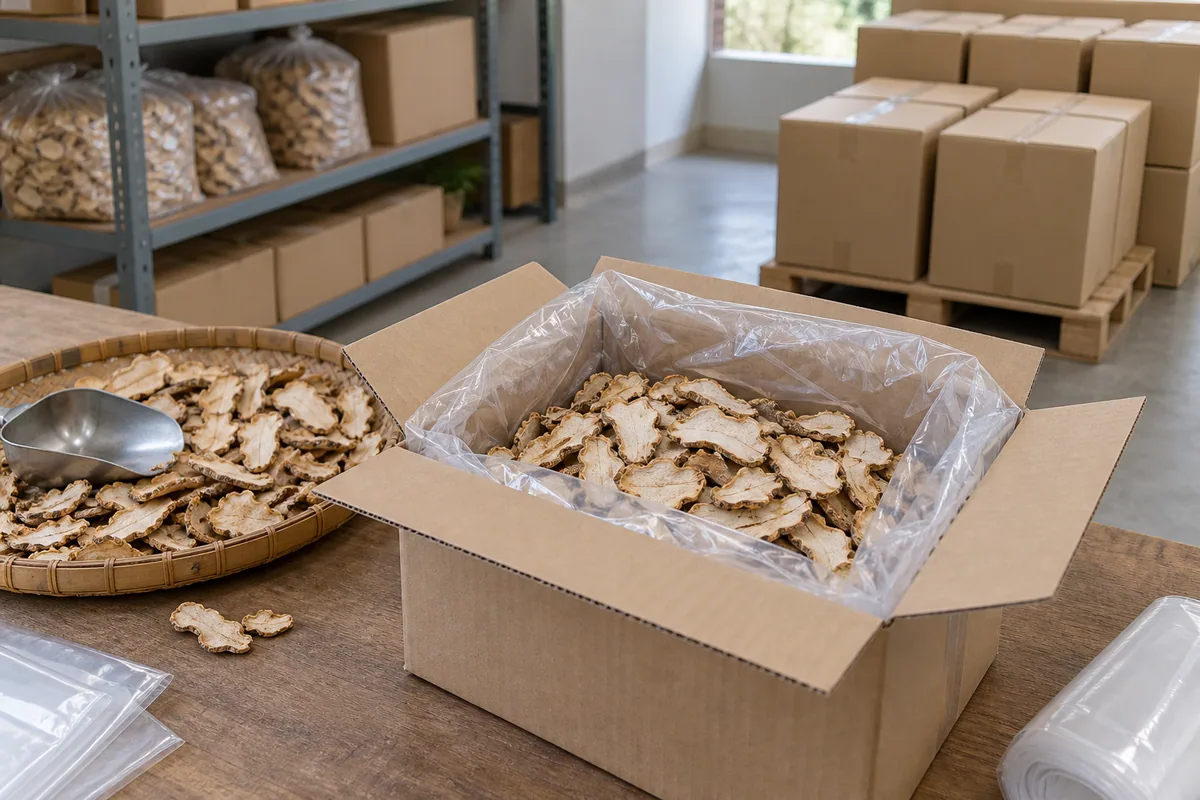
Packing is the control that carries dried galangal from release at the supplier to receiving at the buyer. If the liner opens, the carton crushes, the label separates from the lot, or moisture enters during storage and transport, earlier processing and testing can lose value. A packing specification should therefore be treated as part of product quality, not as a final purchasing detail.
The best pack depends on format, net weight, route, handling, pallet plan, buyer equipment, storage, food-contact policy, and destination rules. A bag that works for large chunks may not control fines from slices. A carton that protects appearance may use container space differently. There is no single “export packing” that answers every order.
This guide gives importers, warehouse teams, and manufacturers a practical way to specify, inspect, store, and receive dried Alpinia galanga. Final materials, dimensions, shelf life, labels, and route controls must be confirmed for the actual product and order.
The packing decision should follow the product decision. Compare dried galangal slices with whole or chunk dried galangal before selecting pack geometry. For the wider buying sequence, use the complete B2B buyer’s guide, then connect this packing plan to the written specification and import document checklist.
1. Begin With the Product Format and Route
Dried galangal slices, whole pieces, and chunks create different packing stresses. Slices can create small fragments and fines. Irregular chunks can press against liners and leave more open space. Long pieces can bridge or break at joints. The buyer should describe the accepted format before selecting pack size.
Route conditions also matter. Consider total transit time, climate changes, transshipment, container handling, pallet movement, warehouse conditions, and the number of times packs will be opened or transferred. A short sample courier route does not represent a full commercial sea shipment.
The buyer’s receiving system should influence the design. Ask whether workers lift individual packs, whether a vacuum or hopper empties the liner, whether the product is repacked, and whether pallet dimensions must fit fixed racking. A theoretically protective pack can still be inefficient or unsafe in use.
Write the route assumption into the quotation. If the destination, Incoterm, palletization, or transport mode changes, review the pack again instead of carrying the old choice forward automatically.
2. Specify the Food-Contact Inner Layer
The inner liner or bag directly protects the ingredient. State material type, food-contact suitability, dimensions or capacity, thickness where relevant, color requirement, and supplier documentation needed by the buyer. If recycled content, migration evidence, or a declaration of compliance is required, include it before order approval.
The liner must fit the product and outer pack. It should provide enough room for filling and closure without excessive loose material that can fold into weak points. Irregular galangal pieces should not puncture the liner under normal filling and handling. Small slices and fines should not escape through seams or closures.
Do not assume that a thicker liner always provides the best moisture protection. Material structure, seams, closure, handling, and barrier properties all matter. Ask the packaging supplier or technical team for evidence appropriate to the use.
Inspect liners before filling and after closure. Record damage, contamination, incorrect material, poor seals, or trapped product in the closure. Define what happens to a pack that fails inspection.
3. Define the Closure Method
A liner described as “included” is incomplete without a closure. The specification should state whether the liner is heat sealed, tied, folded and secured, clipped, or closed by another approved method. The chosen method must suit the material, equipment, and route.
Heat sealing needs controlled time, temperature, pressure, clean seal area, and verification. Ties or clips need defined material and application. Folding alone may not provide the same protection as a sealed closure. The buyer should decide the required level based on moisture, contamination, and handling risk.
Outer closure also matters. Carton tape, stitching, straps, or bag sewing should keep the pack intact without damaging the liner. Staples or metal fasteners may be prohibited by the buyer’s physical-hazard policy. State that requirement explicitly.
Opening convenience should be considered. A closure that is difficult to open cleanly can create packaging fragments or product loss at receiving. Balance protection with safe use.
4. Choose the Outer Bag or Carton
The outer pack provides mechanical protection, stacking strength, handling surface, and space for required marks. Common options may include multiwall bags, woven outer bags, or corrugated cartons with an inner liner. The correct choice depends on the product and buyer requirement.
Cartons can protect visible slices and create regular pallet geometry, but board grade, flute, dimensions, humidity resistance, tape, stacking, and pallet pattern affect performance. Bags can use space efficiently and may suit industrial emptying, but they can transmit compression and abrasion differently.
Specify dimensions and construction rather than relying on a sample from another order. Confirm that the pack can hold the stated net weight without excessive compression, bulging, or unused volume. Run a packing trial if the geometry is new.
The outer material should arrive clean, dry, odor-free, and protected. Packaging storage can contaminate a food product before filling if cartons or bags are exposed to dust, pests, water, or strong chemicals.
5. Set Net Weight and Weight Control
State net weight per pack and the allowed tolerance under applicable law and the commercial agreement. Define how scales are checked, when weights are recorded, and how underweight or damaged units are handled.
Consider manual handling. A heavier pack may reduce unit count but can increase injury risk, breakage, liner stress, and difficulty during repacking. The buyer’s warehouse and local workplace requirements should guide the practical limit.
Format changes packing density. The same carton can hold different weights of slices and chunks. Do not fix net weight without a representative packing trial or current data. Confirm approximate gross weight and external dimensions for freight and warehouse planning.
Packing-list totals must match the sum of units. If different lots, formats, or weights share a shipment, separate them clearly. Reconcile product, lot, pack count, net weight, gross weight, and pallet count before document issue.
6. Write Complete and Consistent Labels
The buyer should supply or approve a label template. Typical information may include product name, botanical name, format, net weight, lot or batch code, origin, production or packing date, best-before information where supported, storage instructions, supplier, consignee code, and order reference.
The exact requirement depends on whether the pack is a bulk industrial unit, a retail unit, or an input for further processing. Destination language, allergen, treatment, organic, nutrition, or other statements must follow applicable rules and evidence. Do not add a marketing claim because it appears on a competitor’s bag.
Labels should remain legible and attached through the route. Placement should allow warehouse scanning or reading without moving unsafe loads. If barcodes are used, test the data and print quality.
Use the same master data for labels and documents. Spelling, botanical name, lot, dates, quantities, weights, origin, and order reference should agree. A small mismatch can create customs or receiving delays.
7. Plan Pallets and Load Stability
Confirm whether pallets are used, who provides them, dimensions, material, treatment or marking requirements, maximum height, maximum weight, overhang rules, interlayers, corner protection, straps, and stretch wrap. Requirements can vary by destination and buyer.
A stable pallet protects packs during forklift movement and transport. Pattern and height should prevent shifting and crushing. Carton compression can change with humidity and time, so a short warehouse stack test may not represent a long route.
Wood packaging can be subject to plant-health requirements such as ISPM 15 when applicable. The importer and logistics provider should verify the current rule for the destination and chosen material. Alternative pallets also need strength and buyer acceptance.
Record pallet identity and which lots or pack ranges it contains. Mixed lots should be avoided or clearly mapped. Pallet labels should not replace unit-level identity when the commercial agreement requires unit traceability.
8. Store Finished Dried Galangal Correctly
Use a clean, dry, pest-controlled storage area. Protect packs from roof leaks, plumbing, floor water, condensation, chemicals, smoke, and strong odors. Maintain separation from rejected, held, returned, or differently identified material.
Keep lot and release status visible. A physical boundary, warehouse location, system status, or combined control can prevent unapproved material from shipping. Restrict label access and record movements.
Monitor conditions that matter to the product and pack. The exact temperature and humidity limits should be supported by the specification and stability evidence. Avoid publishing a generic value without product and route validation.
Use appropriate stock rotation. First in, first out may be useful, while first expired, first out is stronger where supported expiry dates differ. Inspect packs during storage for damage, pest evidence, wetting, or label loss.
9. Support Shelf-Life Claims With Evidence
Shelf life is the period during which the product is expected to meet the defined specification under stated pack and storage conditions. It is not a number that belongs to dried galangal in every format and climate.
A study or history should consider moisture, water activity where relevant, microbiology, sensory profile, appearance, volatile components where critical, pack integrity, and other buyer requirements. The endpoint is failure to meet the agreed specification, not merely the passage of time.
State whether the period begins at production, drying completion, packing, or another date. State unopened pack conditions and what applies after opening. If the buyer repacks the product, a new stability assessment may be required.
Use conservative, evidence-based language. If current evidence supports only a target or review period, say so. Do not convert a supplier estimate into a guaranteed expiration date without approval.
10. Inspect the Container or Transport Unit
Before loading, inspect cleanliness, dryness, odor, visible holes, door seals, floor condition, previous-cargo concern where known, and suitability for the planned load. Record the result and any corrective action. Do not load a unit that fails critical checks.
Consider condensation risk. Product, air, container surfaces, route climate, loading conditions, and ventilation choices interact. Desiccants may support a plan but are not a substitute for dry product, sound packs, and a suitable container. Their type, quantity, placement, and handling should be reviewed.
Protect cargo from direct contact with wet or contaminated surfaces. Use approved lining, pallets, dunnage, or separation where required. Avoid blocking necessary air paths if the route plan depends on them.
Record loading photographs, pallet or pack count, lot, container number, seal number, date, and responsible party where these records are part of the evidence plan. The actual transfer of risk follows the agreed Incoterm and contract.
11. Control Receiving and Warehouse Entry
The buyer should inspect the transport unit before unloading. Record seal, exterior condition, door area, odor, visible water, condensation, shifted cargo, damaged packs, pests, and temperature or humidity evidence where specified.
Sample according to the approved plan. Do not select only clean and accessible packs. If damage is localized, identify the position and lot. Separate compromised product while the investigation proceeds.
Check labels, counts, weights, pack integrity, and document matches. Note any difference between pre-shipment photographs and receiving condition. Preserve packaging and transport evidence when a claim may be needed.
Move accepted material into the defined storage condition promptly. Leaving dried galangal open on a humid dock can change the condition before quality sampling is complete.
12. Manage Open Packs and Repacking
Once the liner is opened, the original protection changes. Define maximum open time, temporary closure, environmental condition, utensils, personnel hygiene, foreign-material prevention, and remainder labeling. Use clean, dedicated or controlled equipment.
Repacking creates a new process step. The buyer may need new labels, weights, pack materials, lot mapping, checks, and shelf-life decisions. Keep the original supplier lot traceable through every new unit.
If material is returned to storage, inspect the liner and outer pack. Do not combine residues from different lots without authorization and records. Small unidentified quantities can create large traceability gaps.
For production use, issue material by lot and reconcile quantities. This supports investigation if a finished food question later arises.
Packing and Storage Checklist
- Confirm slices or whole and chunk geometry and expected fines.
- State route, handling, warehouse, and receiving assumptions.
- Specify food-contact inner material, dimensions, and required declarations.
- Define liner closure and verification.
- Specify outer pack construction, dimensions, and closure.
- Set net weight, tolerance, scale control, and manual handling limit.
- Approve every label field and its source.
- Define pallet material, dimensions, pattern, height, and stability controls.
- Protect packaging materials and finished product in dry, pest-controlled storage.
- Link shelf life to product, pack, storage, method, and end specification.
- Inspect and record the container or transport unit before loading.
- Record lot, counts, loading condition, container, and seal where applicable.
- Define receiving inspection, isolation, sampling, and claim evidence.
- Control open packs, repacking, remainder identity, and stock rotation.
Frequently Asked Questions
What is the best package for dried galangal?
There is no universal best package. The buyer should select the inner liner, closure, outer pack, net weight, and pallet plan for the format, route, food-contact policy, storage, and receiving process. Confirm the design through current data or a packing trial.
Can dried galangal be packed in cartons?
Cartons can be considered with an appropriate inner food-contact liner and approved construction. Board strength, dimensions, closure, stacking, humidity, pallet pattern, and route must fit the order. Confirm current feasibility in the quotation.
How long can dried galangal be stored?
Use an evidence-based shelf life tied to the specific product, pack, storage conditions, and required end-of-life specification. Do not rely on one generic duration. Ask what study, history, or test plan supports the stated period.
Are desiccants required in every container?
No universal rule applies. Condensation risk depends on product, moisture, packaging, route, climate, loading, and container condition. Desiccants can support a documented plan, but their use and placement should be technically reviewed.
How can a buyer discuss packing with PT Tri Global Export?
Send the product format, net weight preference, liner or carton requirement, pallet need, destination port, route, and receiving constraints through the contact page. Current feasibility and commercial effect will be confirmed in writing.
Sources and Verification
- Codex CXC 42-1995 for general hygienic practice covering packing, storage, and transportation of spices and dried aromatic herbs.
- European Commission official controls for current EU food import control context.
- PT Tri Global Export shipping page for the site’s current shipment-planning basis.
This article is educational. It does not prescribe one package, storage limit, shelf life, container method, or destination label. Confirm the complete packing and transport specification for each order.
Prepared for buyer education. Product, test, document, availability, price, and destination requirements remain subject to written verification for the relevant order and lot.