
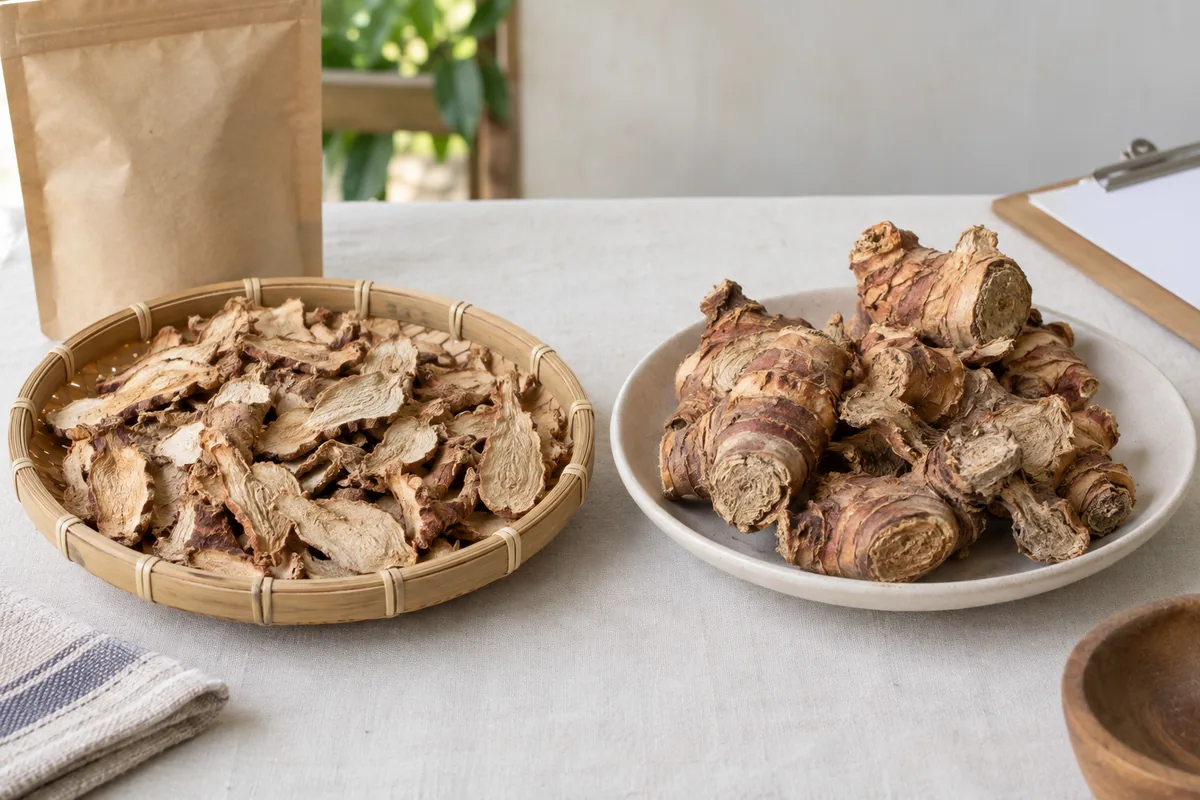
Dried galangal is a small category with a surprisingly large number of buying decisions. A buyer may ask for “dried galangal” and receive slices, irregular chips, large chunks, or nearly whole rhizomes. Two offers may use the same product name but represent different moisture targets, cleaning steps, packing systems, test scopes, and levels of lot evidence. The lowest quoted number is therefore not automatically the lowest usable cost.
This guide gives importers, food manufacturers, spice processors, and distributors a practical way to buy Indonesian dried galangal. It explains the decisions that should be made before asking for a price. It also explains what evidence should connect the approved requirement to the material that is eventually released. The objective is not to create a universal grade. The objective is to make one buyer requirement clear enough to inspect, quote, pack, and review.
The accepted botanical name used in this guide is Alpinia galanga (L.) Willd. The Royal Botanic Gardens, Kew lists the species as accepted and records Java and Sumatra within its native range. A purchase specification should still state the botanical name because several different plants are called galangal in international trade. A common name alone is not a reliable identity control.
Readers who are new to the ingredient can begin with What Is Galangal?. Product developers can then use the practical guide on how to use dried galangal. Claims and research teams should review potential galangal benefits and the limits of current evidence before describing any health-related property.
1. Start With the Buyer’s Application
The best dried galangal format depends on what happens after the material reaches the buyer. A tea or infusion producer may want visible slices with a repeatable thickness. A seasoning plant may need a size that feeds predictably into a blender. An extractor may care about identity, moisture, volatile oil, and the relationship between the tested sample and the commercial lot. A buyer with an in-house mill may prefer larger pieces because the plant already controls final particle size.
Begin the sourcing brief with the next process, not with a marketing grade. State whether the material will be infused, blended, milled, extracted, repacked, or used as a visible ingredient. Add any equipment constraint that can affect the decision, such as a feed opening, screen size, or need for a visible cut. This information helps the supplier recommend a useful format without guessing.
The application also helps remove unnecessary cost. A buyer who will grind the material immediately may not need tightly sorted slices. A buyer who sells visible botanicals may need close attention to cut faces, color distribution, fines, and breakage. Neither requirement is universally better. Each requirement is better only when it fits the buyer’s operation.
For a first review, compare the two formats on the dried galangal products page. The product pages show where dried galangal slices and whole or chunk dried galangal usually fit. The final choice should be written into the order specification.
2. Confirm Botanical and Commercial Identity
Botanical identity is the first specification line because the word “galangal” can refer to more than one species. Alpinia galanga is often called greater galangal, Java galangal, Siamese ginger, or lengkuas. Other plants may carry similar common names. The buyer should state the accepted botanical name and the plant part, which is the rhizome in this product category.
Commercial identity adds details that botanical identity does not provide. State the origin, dried condition, format, intended food use, and whether the material is a finished ingredient or will receive further processing. A clear description might read: “Dried Alpinia galanga rhizome slices, Indonesia origin, for further food manufacturing.” The exact wording should match the buyer’s regulatory and labeling needs.
Photographs can support identity review, but photographs do not replace a retained physical sample or appropriate analytical work. Color changes with harvest condition, drying, lighting, camera settings, and screen display. Shape also varies naturally. Treat images as orientation evidence. Treat the written description, identified sample, lot records, and agreed tests as the acceptance system.
When a supplier uses a common name, ask which botanical species that name represents. When a specification names a species, ask how the represented sample and lot are linked to that identity. These are ordinary buyer questions. They do not imply distrust. They prevent a basic naming difference from becoming an expensive problem after arrival.
3. Choose Slices or Whole and Chunk Material
Dried galangal slices provide a visible cut. Thickness, diameter distribution, broken pieces, and fines can be inspected before the material enters a process. This format can be useful for infusion, blending, seasoning, visible botanical applications, and extraction programs that want a more consistent presentation. Slices also make internal comparison easier when a buyer retains samples from different lots.
Whole and chunk material leaves more size reduction to the buyer. “Whole” should not be interpreted as one universal piece size. A dried rhizome may separate naturally, and handling can create breakage. The order should define the acceptable piece profile, the relationship between whole pieces and chunks, and any limit for smaller broken material. Buyers with milling or grading equipment often choose this route because they prefer to control the final cut in-house.
The two formats can have different packing density, breakage behavior, and inspection needs. Thin pieces may create more fines during repeated handling. Large pieces may use carton or bag volume differently and can require a clearer piece-size definition. These practical effects should be discussed before the net weight and pack dimensions are fixed.
Do not compare a slice quotation with a whole or chunk quotation as if only the shape changed. Cutting, sorting, yield loss, packing density, and buyer-side processing all affect the commercial basis. Use the detailed format comparison article to choose a starting route, then confirm the choice against a representative sample.
4. Turn Quality Words Into Measurable Requirements
Words such as premium, clean, export quality, and natural are not acceptance criteria. They may describe an intention, but two teams can interpret them differently. A useful dried galangal specification replaces broad adjectives with parameters, limits, methods, units, and decision rules.
Start with physical requirements. These may include format, target cut thickness or piece range, color reference, odor, visible defects, foreign matter, infestation, fines, and broken-piece distribution. Not every buyer needs every parameter. Include the attributes that affect safety, legality, processing, yield, or presentation for the intended application.
Then define compositional and safety-related requirements. Moisture is commonly included because it affects paid weight, storage behavior, and lot comparison. Water activity may be useful where the buyer’s hazard analysis requires it, but it is not interchangeable with moisture percentage. Ash, acid-insoluble ash, volatile oil, pesticide residues, heavy metals, mycotoxins, and microbiological criteria may be relevant depending on use and destination. The required list must come from the buyer’s product risk review and applicable rules, not from a copied generic certificate.
Every numerical limit needs a method and reporting basis. A moisture result without the test method, sample identity, and units may not be comparable with a second result. A statement such as “foreign matter maximum 1%” also needs a sampling and inspection rule. The dried galangal specification guide explains how to build this matrix without pretending that one set of limits suits every buyer.
5. Use Samples as Controlled References
A sample is valuable only when both parties know what it represents. A general sales sample can demonstrate the product type, but it may not represent the lot available for shipment. A current-lot sample can support a release decision, but only if the sampling route and lot relationship are recorded. Ask the supplier to identify the sample as representative, indicative, or current-lot material.
Review the sample in a consistent setting. Use neutral light and a clean surface. Record identity, aroma, appearance, cut distribution, breakage, fines, visible foreign matter, and any application trial. If several people approve the sample, record the names or functions of the reviewers and the date. Avoid an approval that exists only in a message thread without a sample code.
Retain enough material for later comparison when practical. Seal it, identify it, and protect it from moisture, odor, pests, and excessive light. A retained sample does not remain unchanged forever, so record its storage conditions and review date. The purpose is to preserve a useful reference, not to create a permanent standard from a perishable agricultural material.
Before a commercial order, connect the approved sample to the written specification. State which attributes are controlled by the sample and which are controlled by numbers or test methods. Use the sample evaluation workflow to keep visual approval, analytical evidence, and lot identity in their proper roles.
6. Review Processing and Food Safety Controls
Dried spices and aromatic herbs can carry biological, chemical, and physical hazards. Dry appearance does not mean zero risk. The Codex code of hygienic practice for spices and dried aromatic herbs describes hygienic principles from primary production through processing, packing, storage, and transportation. A buyer should use a product-specific hazard analysis and applicable destination rules when deciding which controls and evidence are necessary.
A practical supplier review starts with the process flow. Ask how fresh rhizomes are received, cleaned, cut where applicable, dried, sorted, packed, identified, stored, and released. The buyer does not need an elaborate presentation. The buyer needs a sequence that explains where contamination, mix-up, moisture gain, or foreign material could enter and how each relevant risk is controlled.
Testing is one part of verification, not the whole system. A laboratory result describes the submitted sample under the stated method. It does not automatically prove the condition of every package. Sampling, lot definition, chain of custody, method, laboratory competence, and release decision determine how much confidence the result provides. A long list of tests can still be weak evidence if the sample identity is unclear.
Ask what happens when a result or inspection falls outside the written requirement. A credible answer should include hold, investigation, retest where justified, rework where allowed, concession with buyer approval, downgrade, or rejection. The food safety and quality control guide provides a fuller framework for this review.
7. Plan Packing, Storage, and Transport Together
Packing protects dried galangal from moisture, contamination, odor transfer, physical loss, and handling damage. The right pack depends on the format, net weight, route, storage conditions, pallet plan, and the buyer’s receiving system. “Export packing” is not a complete description. Write the inner food-contact layer, outer pack, closure, net weight, marking, and pallet requirement.
The inner liner and closure deserve specific attention. The liner should be compatible with food use and the planned route. The closure should remain intact through filling, handling, and transport. The outer bag or carton should provide the required mechanical protection. If the buyer has a policy for material type, thickness, migration documentation, recycled content, or disposal, state that policy before quotation.
Storage instructions should be practical and measurable. Use a dry, clean, pest-controlled area. Keep packs away from direct water exposure, strong odors, and conditions that can cause condensation. Record stock rotation and lot identity. Do not publish or accept a fixed shelf life without evidence tied to the product, pack, storage conditions, and required end-of-life specification.
Container and route planning also matter. The loading plan should reduce crushing, water exposure, and movement. Container condition should be checked before loading. The parties should agree who records loading, seal identity, and dispatch details. The packing and storage guide turns these points into a buyer checklist.
8. Define the Document Set by Destination
Commercial documents commonly include a commercial invoice, packing list, and transport document. A certificate of origin, phytosanitary certificate, health-related document, laboratory report, treatment record, or other declaration may be required depending on product classification, buyer use, destination, and current law. No single document list is correct for every dried galangal shipment.
The importer or appointed broker should verify the current requirement before the supplier finalizes the quotation. This step matters because a document may require an application, inspection, sample, statement, or timing decision before cargo is loaded. Discovering the requirement after dispatch can create delay that neither party can solve with a revised invoice.
For the United States, the FDA explains that prior notice is generally required before food is offered for import and that covered importers may have responsibilities under the Foreign Supplier Verification Programs rule. The exact responsibilities and exemptions depend on the transaction and parties. For the European Union, official controls and maximum residue limits operate under current EU rules and risk-based controls. Buyers should verify the latest product and origin conditions with the competent authority and broker.
Use the dried galangal import document checklist as a planning tool. It is not legal advice and does not replace an official destination review. It helps the buyer and exporter assign each required document, source, deadline, and matching data field before shipment.
9. Compare Quotations on the Same Basis
A useful quotation should identify the product, format, specification basis, quantity, packing, Incoterm, named place or port, currency, validity, lead-time basis, payment terms, test scope, document scope, and the lot or availability assumption. If one offer excludes a test panel or uses a different moisture target, the headline numbers are not directly comparable.
Price can change with raw material availability, processing yield, cut definition, sorting tolerance, packing, test scope, volume, route, and timing. This is why a supplier may not publish a dependable fixed price online. A public number must assume details that may not match the actual order. A written brief produces a narrower and more useful commercial answer.
Compare landed and usable value, not only price per metric ton. Higher moisture can increase the amount of water purchased and transported. A broad cut distribution may require more rework. Weak packing can create loss. Missing documentation can create clearance costs. These effects do not mean that the highest quote is best. They mean that the buyer should make the hidden assumptions visible.
The bulk quotation comparison guide includes a side-by-side review method. The existing pricing guide also explains the main inputs behind a dried galangal price.
10. Qualify the Supplier and the Specific Order
Company review and order review are related but different. Company review asks whether the legal entity, contact details, operating scope, and records are credible. Order review asks whether the supplier can meet this specification, volume, timing, and destination requirement from a defined lot or production plan.
Verify the legal company name and the name that appears on commercial documents. Confirm the operating contact, physical location, quotation channel, payment instructions, and authority to sign. Treat last-minute changes to bank details or identity as a reason to stop and verify through a known channel. Basic commercial controls protect both buyer and supplier.
For the order itself, request the specification, identified sample basis, packing plan, evidence plan, and release sequence. Ask which details remain provisional. Agricultural supply changes, so an honest provisional answer is more useful than an unconditional promise. The written record should distinguish a target, a current-lot result, a buyer requirement, and a confirmed commitment.
Start with a sample or a commercial quantity that fits the buyer’s qualification process. A smaller first order can reduce exposure, but it does not remove the need for documents, safety review, or a clear specification. The safe first step is the one that produces enough evidence for the next decision.
Buyer Checklist Before Sending an RFQ
Use the following checklist to prepare a concise request:
- State Alpinia galanga rhizome and Indonesia origin if those points are required.
- Choose slices or whole and chunk material, then define the relevant cut or piece profile.
- Describe the application and the next processing step.
- List the measurable physical, compositional, safety, and legal requirements.
- State the test method, sampling basis, units, and decision rule where a numerical result is required.
- Identify whether the requested sample is indicative or tied to a current lot.
- Define inner packing, outer packing, net weight, closure, marking, and pallet needs.
- Give the trial or commercial volume and expected order frequency.
- Name the destination country, destination port, and preferred Incoterm.
- Ask the importer or broker to confirm the current document and import-control requirements.
- Request the availability basis, quotation validity, lead-time basis, and evidence available before release.
- Keep every final requirement in one approved specification rather than scattered across messages.
A complete brief does not need to be long. It needs to make the important decisions visible. If several details are unknown, state that they are open for recommendation. A supplier can respond to an open item. A supplier cannot respond accurately to a hidden assumption.
Frequently Asked Questions
Is Indonesian dried galangal the same as ginger?
No. Galangal and ginger are different botanical materials, although both belong to the Zingiberaceae family. The purchase description should name Alpinia galanga when that is the required species. Buyers comparing formulation behavior can also read the galangal and ginger guide.
Which dried galangal format is best for food manufacturing?
There is no universal best format. Slices support visible cut inspection and may suit infusion or blending. Whole and chunk material may suit buyers who mill or grade in-house. The correct choice depends on equipment, application, inspection needs, packing, and total processing cost.
What moisture level should a buyer request?
The buyer should set a moisture limit that fits product stability, process needs, destination rules, packing, route, and the selected test method. A copied number without a method or storage plan is incomplete. The final limit should be agreed in writing and verified against the relevant sample or lot.
Does a certificate of analysis guarantee the shipment?
A certificate of analysis reports results for an identified sample. Its value depends on sampling, lot definition, method, laboratory, and chain of custody. It should be reviewed with the specification, physical inspection, packing records, and traceability information. It is evidence, not a substitute for the complete control system.
Can PT Tri Global Export quote without a full specification?
An initial commercial discussion can start with format, application, volume, and destination. Final confirmation requires a written basis that identifies the product, acceptance requirements, packing, documents, and commercial terms. Use the contact page to send the starting brief.
Sources and Verification
- Kew Plants of the World Online: Alpinia galanga for the accepted botanical name and recorded distribution.
- Codex CXC 42-1995 for general hygienic practice covering spices and dried aromatic herbs.
- FDA: Importing Human Foods and FDA FSVP guidance for United States importer planning.
- European Commission: Official Controls and Enforcement and the EU Pesticides Database for current EU control and residue-reference tools.
This article is a buyer-planning resource, not legal advice, a product guarantee, or a current-lot certificate. Requirements can change. Confirm the applicable rules and evidence for the product, use, origin, destination, and shipment date before commitment.
Prepared for buyer education. Product, test, document, availability, price, and destination requirements remain subject to written verification for the relevant order and lot.