
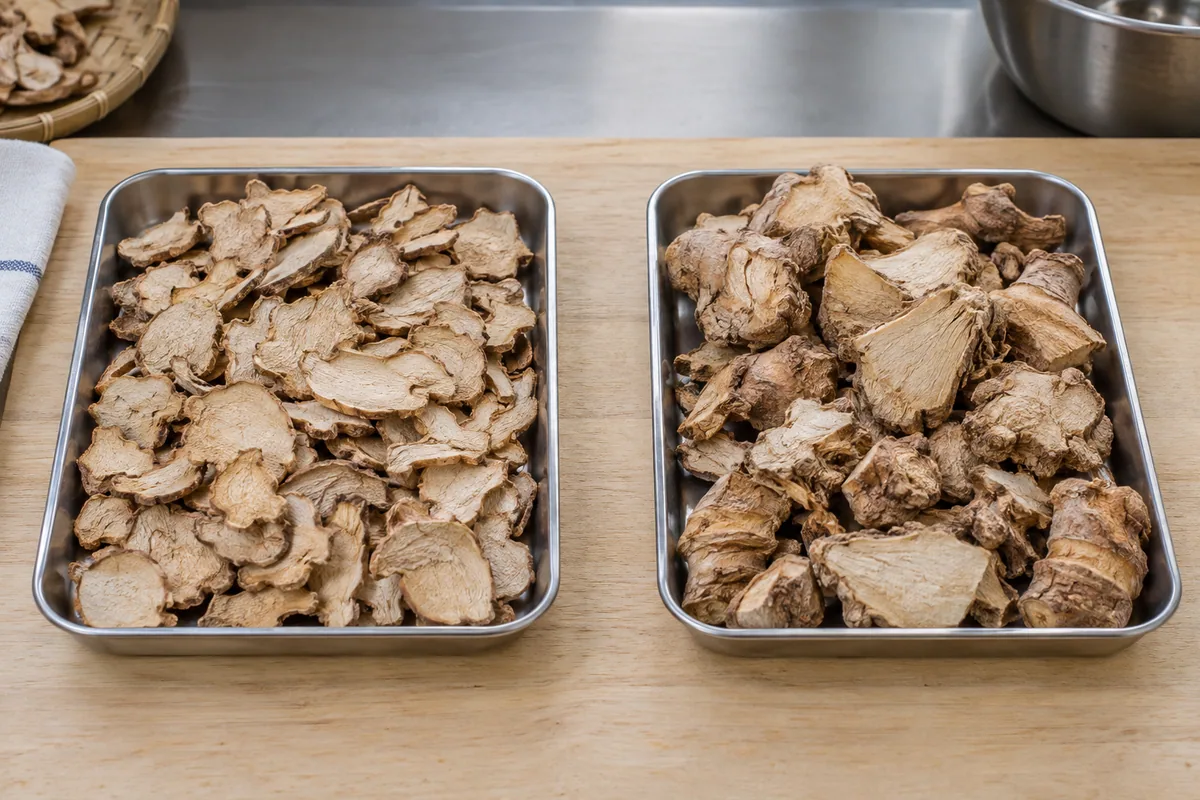
A buyer choosing between dried galangal slices and whole or chunk material is not choosing between a good product and a better product. The buyer is deciding where size reduction, visual inspection, breakage control, and process responsibility should sit in the supply chain. Slices move more of that work to the supplier. Whole and chunk material leaves more of it with the buyer.
That difference affects more than appearance. Format can change packing density, the amount of fines created during handling, the way a sample is evaluated, the type of receiving inspection that makes sense, and the cost of downstream milling. A useful comparison therefore starts with the buyer’s equipment and finished product, not with a generic grade name.
This guide compares the two dried Alpinia galanga formats supplied by PT Tri Global Export. The final cut, tolerance, moisture, packing, testing, and lot evidence must be confirmed in writing for each order.
1. Define What “Slices,” “Whole,” and “Chunk” Mean
A product name is not a size specification. “Slices” can describe thin coins, cross-cut pieces, lengthwise pieces, or a broad mixture of shapes. “Whole” can describe complete rhizomes, major branches, or large pieces that remain after drying. “Chunk” can range from short segments to irregular broken material. The buyer should never assume that the seller’s internal definition matches the buyer’s receiving standard.
For slices, write the target thickness and an acceptable distribution. Decide whether diameter matters, whether skin remains, how broken pieces are classified, and where fines begin. A single nominal thickness is not enough because agricultural material and cutting systems create variation. The acceptance rule should say how many pieces are checked and what percentage may fall outside the target.
For whole and chunk material, define the intended piece profile in words, images, dimensions, or a retained sample. State whether whole rhizome branches are required, whether cut ends are acceptable, and how smaller pieces are treated. A sieve may help for small material, but large irregular rhizomes are often better controlled with an agreed visual and dimensional method.
Use the specific dried galangal slices page and dried galangal whole and chunk page as starting references. Then replace any broad website description with the order-specific definition that both parties approve.
2. Match the Format to the Next Processing Step
The next processing step is the strongest format selector. A buyer who feeds dried galangal directly into an infusion system may value consistent visible pieces. A seasoning producer may want a defined cut that blends evenly with other botanicals. A company that displays the ingredient through transparent packaging may place more weight on appearance and cut distribution.
A buyer with an industrial mill can often accept larger pieces. The plant already controls the final screen, particle distribution, and blending sequence. Paying for a supplier to create a tighter slice may add a step that the buyer immediately repeats. In that case, whole or chunk material can be the simpler input, provided the received piece size is compatible with the mill and handling system.
Extraction programs require a separate review. Surface area can affect wetting, loading, and extraction behavior, but the preferred size depends on the extraction method and equipment. Smaller is not automatically better. Very fine material can create handling, filtration, or dust problems. Larger pieces can take longer to wet or may require pre-milling. The technical team should define the workable feed form before procurement requests a quote.
Describe the application in plain language: “visible herbal infusion,” “pre-mill input,” “coarse spice blend,” or “further extraction after milling.” This simple statement gives the supplier a reason for the cut requirement and makes substitutions easier to evaluate.
3. Compare Inspection and Sampling
Slices make some characteristics easier to see. A reviewer can compare cut faces, thickness, color distribution, breakage, and fines across a spread sample. The larger number of individual pieces can also provide a broader visual view of the material. However, a convenient visual review does not prove botanical identity or food safety. It is one part of the evidence set.
Whole and chunk material can make internal condition less visible until a piece is broken or cut. The sampling plan may therefore include opening representative pieces to inspect the interior. The reviewer may also record the distribution of large pieces, medium chunks, and small broken material. A single photograph of the top of a bag cannot represent the full pack.
Sampling should account for segregation. Vibration during filling and transport can move smaller pieces and fines toward different areas of a package. Taking material only from the top can give a biased result. Agree on the number of packs, sampling locations, combined sample procedure, and retained sample before the inspection is performed.
The sample report should name the format and lot, not only “galangal.” If both formats are ordered, treat them as separate product lines with separate sample identities, results, and acceptance decisions. The sample evaluation guide provides a practical sequence for both formats.
4. Understand Breakage, Fines, and Handling
Dried rhizomes are brittle enough to change during handling. Thin slices can break at edges and create small fragments when bags are dropped, compressed, or moved repeatedly. Large pieces can also split at natural joints. The amount of change depends on dryness, piece geometry, pack type, fill weight, route, stacking, and the number of handling events.
This does not mean that one format is always stronger. A thick slice may travel better than a thin slice, while a long dried rhizome branch may break at a weak point. The buyer should define which size fractions remain usable. If smaller pieces can enter the same mill or blend, the commercial effect may be limited. If visible presentation is important, the same breakage can be a major defect.
Write the acceptance rule at the point where it will be applied. A pre-shipment sample and a receiving sample may show different breakage after transport. If the buyer needs a receiving guarantee, the parties should discuss packing trials, handling assumptions, and how transit-related damage will be assessed. A supplier cannot control every event after handover, while a buyer should not receive a format that was already outside tolerance before dispatch.
Ask for photographs of the packed material and loading condition when appropriate. These images support the record but do not replace inspection. The goal is to distinguish production variation from packing or transit effects.
5. Compare Packing Density and Logistics
Format affects how material occupies a bag or carton. Flat slices can settle and interlock. Large irregular pieces can leave more open space. The practical result depends on actual geometry, moisture, pack dimensions, and filling method. Do not assume a standard weight per carton from the product name alone.
Confirm net weight and approximate outer dimensions during quotation. These figures help the buyer estimate pallet count, container use, warehouse space, and handling. They also help prevent a quotation comparison in which one supplier assumes a different pack weight or pallet plan. Final load planning should use confirmed packing data, not a generic density from another product.
The inner liner and outer pack must suit the format. Sharp or rigid edges can stress a thin liner. Small pieces and fines can escape through weak closures. Heavy packs can increase breakage or manual handling risk. State the liner, closure, outer material, net weight, and any pallet or slip-sheet requirement.
If the buyer repacks into smaller units, note the receiving and opening process. A format that flows poorly from a liner may add labor. A format that creates dust may require local controls. Logistics should support the next operation rather than end at the warehouse door. More detail is available in the dried galangal packing and storage guide.
6. Compare Supplier-Side and Buyer-Side Processing
Slices require cutting before or during the drying route, depending on the agreed process. Cutting creates more exposed surface and a different drying behavior than larger pieces. It also creates a need to control thickness, blade condition, cleaning, cross-contamination risk, and the classification of off-size material. Additional sorting may be required if the buyer sets a narrow distribution.
Whole and chunk material reduces some supplier-side sizing work, but it still requires cleaning, drying, sorting, and a written piece definition. “Less processed” should not be confused with “uncontrolled.” The buyer still needs identity, moisture, cleanliness, defect, packing, and safety requirements. Large pieces must also be dry enough for the agreed condition throughout the relevant material, not only at the surface.
Moving size reduction to the buyer can offer process control, but it also moves labor, yield loss, equipment wear, dust management, and quality responsibility. Procurement should ask the production team what the in-house step actually costs. A lower purchase price can be offset by milling time, cleaning time, waste, or slower throughput.
Moving size reduction to the supplier can simplify receiving, but the buyer needs a clear acceptance method. The most efficient arrangement places each step with the party that can control and verify it best.
7. Compare Moisture and Drying Evidence
Both formats need an agreed moisture requirement and test method. The relationship between piece size and drying can affect sampling and interpretation. Large pieces have a longer path from the center to the surface. Slices have more exposed area but can vary in thickness. Neither observation supports a universal numerical limit; it supports a better sampling and process discussion.
Ask how the sample is prepared for moisture testing. Large pieces may need size reduction before a method is applied. The test report should identify the method, units, sample, lot, and date. If the buyer uses a different receiving method, compare methods before treating a difference as a product failure.
Water activity may support stability assessment when required by the buyer’s hazard analysis. It answers a different question from moisture content. Do not substitute one number for the other without technical review. Storage temperature, relative humidity, pack barrier, and time also influence condition.
The specification should state the release limit and any receiving expectation. It should also state what happens if the result is close to the limit, if duplicate tests differ, or if the pack is damaged. A decision rule written before testing is easier to apply fairly.
8. Compare Aroma, Volatile Oil, and Application Performance
Aroma is important for many galangal applications, but sensory language can be subjective. A buyer may describe a desired profile as warm, citrus-like, pine-like, peppery, or characteristic. Those words help orientation, yet an approved sample and controlled sensory method provide a better reference than adjectives alone.
Volatile oil can be relevant for extraction or flavor applications. If the buyer requires a minimum, write the method, reporting basis, sample identity, and decision rule. Do not assume that visual format predicts oil result. Format, raw material, drying, age, storage, and analytical method can all affect the commercial evaluation.
Application trials can reveal differences that a visual inspection cannot. An infusion buyer can compare loading, extraction time, filtration, color, and sensory outcome under the same recipe. A milling buyer can compare throughput and particle distribution. Record the trial conditions so a later lot is judged on the same basis.
If both formats perform acceptably, commercial and operational factors may decide the order. If only one format works in the process, state the performance reason in the specification. This makes future supplier discussions faster and reduces pressure to accept an unsuitable substitution.
9. Compare Cost on a Usable-Material Basis
The purchase price is only one part of format cost. Add inbound freight, packing disposal, receiving labor, sampling, testing, in-house cutting or milling, process loss, fines, rework, and unusable material. The exact model can be simple. Even a spreadsheet with a few known differences is better than comparing two price-per-ton figures without context.
For slices, ask what cut, tolerance, and fines basis is included. A low slice price may assume a broad distribution. A higher price may include more sorting. For whole and chunk, ask what percentage of smaller broken material is expected and whether the piece profile is controlled by sample, dimension, or screen.
Moisture also affects usable cost because water contributes to paid and transported weight. Compare quotations on the same moisture basis where practical. Do not adjust supplier results mathematically without understanding the test method and contract terms. Use the number to identify a commercial difference that needs clarification.
The bulk dried galangal quotation guide shows how to normalize assumptions before selecting an offer. A reliable quotation states what format work is included and what work remains with the buyer.
10. Use a Simple Format Decision Matrix
The following questions help the technical and purchasing teams choose together:
- Does the buyer need a visible, repeatable cut in the finished or intermediate product?
- Will the material enter a mill, cutter, extractor, infuser, or blender after receiving?
- What piece size can the equipment accept safely and efficiently?
- Are small broken pieces and fines usable, reworkable, or waste?
- Which characteristics must be visible during receiving inspection?
- Does the buyer have the labor, equipment, and dust controls for in-house size reduction?
- How will each format be sampled and tested for moisture and other requirements?
- What inner liner, outer pack, fill weight, and pallet plan suit the chosen geometry?
- Does the quotation include the same sorting, testing, packing, and destination document scope?
- Which format gives the lower total cost per usable unit after the buyer’s processing step?
If the answers remain unclear, request representative samples of both formats. Run the same receiving and application review on each. Keep the lot relationship visible. A comparison based on actual process behavior is stronger than a decision based on photographs.
Frequently Asked Questions
Are dried galangal slices more expensive than whole or chunk material?
Slices may include additional cutting and sorting work, but the final price depends on current raw material, specification, tolerance, moisture, packing, testing, volume, and route. Compare quotations with the same written basis. Do not assume a permanent price relationship.
Are slices better for extraction?
Not automatically. Smaller pieces provide more exposed area, but the preferred feed size depends on the extraction system, loading method, filtration, and any pre-milling step. The buyer should test the format under the actual process or a representative pilot method.
What thickness should dried galangal slices be?
There is no universal thickness for every application. PT Tri Global Export discusses a buyer-defined cut and confirms the target against a sample or current lot. State the equipment and application need, then agree on a target and acceptable distribution.
Does “whole” mean every rhizome is completely intact?
No universal trade definition guarantees that interpretation. Drying and handling can separate rhizome branches. Define whole pieces, chunks, and smaller broken material in the specification. Use dimensions, photographs, a retained sample, or a combined method.
Can both formats be included in one shipment?
Commercial feasibility, segregation, packing, labeling, documentation, quantity, and current availability must be checked for the specific shipment. Treat each format as a separate line with its own specification, lot identity, and pack marking.
Sources and Verification
- Kew Plants of the World Online: Alpinia galanga for accepted botanical identity.
- Codex CXC 42-1995 for general hygienic practice for spices and dried aromatic herbs, including whole and broken forms.
- PT Tri Global Export quality overview for the site’s buyer-defined verification approach.
This article explains format decisions. It does not set a product guarantee or universal grade. Confirm the final format, tolerance, sampling, tests, packing, availability, and commercial terms in the approved order specification.
Prepared for buyer education. Product, test, document, availability, price, and destination requirements remain subject to written verification for the relevant order and lot.