
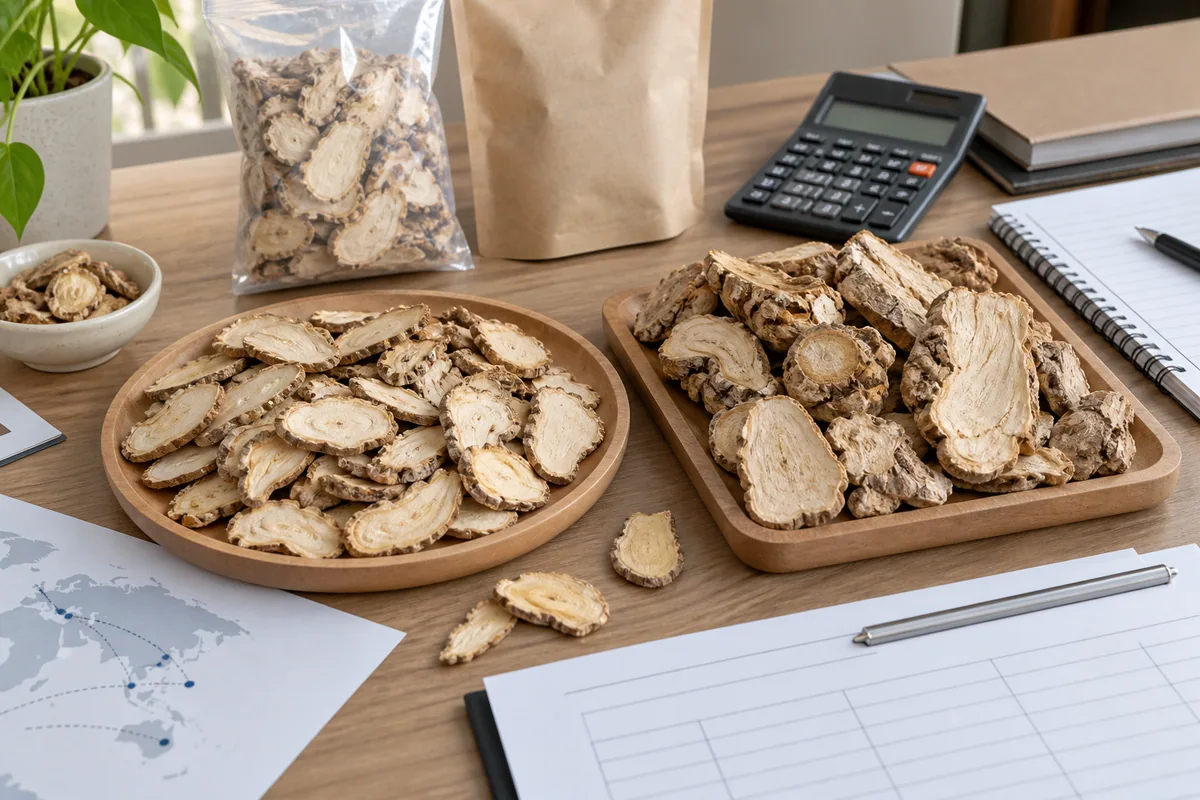
A bulk dried galangal price has meaning only when the product and commercial basis are visible. A quote for broad-cut slices cannot be compared directly with a quote for tightly sorted slices. A whole and chunk offer with a simple bag is different from one with cartons, liners, pallets, tests, and destination documents. Even the same product can show a different number under FOB, CIF, or another Incoterm.
The buyer’s goal is not to force every supplier into the same business model. The goal is to make each offer answer the same set of questions. Once format, specification, quantity, packing, testing, route, timing, and evidence are aligned, price becomes a useful decision input instead of a misleading headline.
This guide explains how to request and compare quotations for dried Alpinia galanga from Indonesia. It does not publish a price or minimum order quantity because current availability and order details must be confirmed.
Review both formats on the dried galangal products page before sending the RFQ. Selecting a format first prevents slice-processing cost and buyer-side milling cost from being mixed in one comparison.
1. Write One Product Description
Begin with botanical and commercial identity. State dried Alpinia galanga rhizome, Indonesia origin if required, slices or whole and chunk format, intended use, and whether the product is for further food manufacturing. Use the same line in every RFQ.
Common names can be added for clarity, but do not let “galangal root” or “Siamese ginger” stand alone. Different species can share similar names. The written specification and later documents should use consistent identity.
If suppliers offer different formats, request separate lines. Do not ask one supplier for slices and another for chunks, then rank the price as if the material were identical. The format comparison guide helps select the route.
List any prohibited substitution. If the buyer cannot accept powder, another species, mixed format, peeled material, treatment, or origin change, state it. Ask the supplier to obtain written approval before changing the description.
2. Attach a Controlled Specification
The RFQ should reference one specification number and revision. Include format, size, appearance, defects, foreign matter, moisture, relevant chemical and microbiological criteria, sampling, methods, packing, labels, and acceptance decisions.
Mark unknown points as open for proposal. A supplier can quote a recommended range if the status is clear. The buyer can then compare proposals and issue a final revision. An empty cell is dangerous because each supplier may fill it silently with a different assumption.
Ask suppliers to list deviations. A compliant quote should not hide a different method or broader tolerance. Use a deviation table with requirement, supplier proposal, reason, and commercial effect.
The dried galangal specification guide provides a complete writing framework. Do not send a copied competitor certificate as the requirement unless every value and method has been technically approved.
3. State Volume and Order Pattern
Give the requested trial or commercial quantity, unit, number of shipments, expected frequency, and acceptable variation. A one-time pallet, mixed load, partial container, and repeated full-container program create different cost and planning conditions.
If demand is a forecast, label it as a forecast. Ask what quantity the supplier can confirm now and what remains subject to raw-material allocation or production. A forecast is useful for planning but should not be presented as a purchase commitment.
Ask for the supplier’s current minimum order quantity for the exact format, pack, and route. MOQ can change with raw material, production campaign, packing, consolidation, testing, and freight. A public generic MOQ may not apply to the requested order.
Consider total annual or program value, but compare the first order on realistic terms. A low price based on uncommitted future volume can create a false benchmark.
4. Define Packing and Palletization
State inner liner, outer bag or carton, net weight, closure, label, pallet type, maximum height, and stretch-wrap or strap needs. Ask for approximate gross weight, dimensions, units per pallet, and pallets per shipment.
If suppliers quote different packs, separate product cost, packing cost, and logistics effect where possible. A heavy bag may reduce units but increase handling and breakage. A carton may protect appearance but use different volume. Compare the pack that fits the buyer’s operation.
Confirm whether pallets, treatment or marking, slip sheets, dunnage, desiccants, container lining, and loading evidence are included. Do not assume “export packing” includes them.
Review the packing and storage guide before fixing the RFQ. Changing pack after quotation can change price, capacity, and lead time.
5. Specify Testing and Inspection
List physical inspections, moisture, microbiological, pesticide, heavy-metal, mycotoxin, volatile-oil, or other tests required for the order. Name the method, limit, sample basis, laboratory requirement, frequency, and report deadline.
Ask which tests are included in the unit price, charged separately, already available for a current lot, or subject to minimum laboratory fees. A quote that excludes the buyer’s required panel is not cheaper on the same basis.
Third-party inspection, witness sampling, preshipment sampling, and retained samples can add cost and time. Assign booking, access, sample courier, laboratory, and report responsibilities.
Testing should follow risk, not a desire for a long certificate. Use the food safety and quality control guide to select meaningful evidence.
6. Define Documents and Destination Scope
Name the destination country and port. Ask the importer or broker to confirm commercial, transport, origin, plant-health, food-safety, treatment, laboratory, label, and buyer-specific documents. Add the confirmed list to the RFQ.
Ask the supplier to mark included, available at extra cost, buyer-provided, broker-provided, conditional, or not available for each item. This prevents a later argument over what “complete export documents” meant.
Document lead times can affect shipment. Official inspection, laboratory analysis, origin applications, and treatment records may require action before loading. Include timing and draft review in the quote.
The import document planning checklist explains how to build the matrix. Requirements can change, so include the verification date.
7. Choose the Incoterm and Named Place
Use the correct Incoterm rule and named place or port. FOB without a named port is incomplete. CIF without a named destination port is incomplete. The 2020 Incoterms rules define responsibilities, but the sales contract still needs clear details.
Ask which local charges, export clearance, terminal handling, ocean or air freight, insurance, destination charges, duties, taxes, inspections, demurrage, storage, and inland delivery are included or excluded. A supplier may not control destination costs.
Compare quotes under the same Incoterm when possible. If not, build a landed-cost bridge using current freight and destination estimates from qualified providers. Record the estimate date because freight changes.
Incoterm does not determine title transfer, payment method, product specification, or every document. Keep those terms in the contract and quotation.
8. State Timing and Availability
Ask for current material status: in stock, current lot under review, raw material allocated, production planned, or subject to confirmation. Request a lead-time basis with start point and dependencies.
“Four weeks” is unclear without a start event. It may begin at purchase order, deposit, final specification, sample approval, packaging approval, laboratory result, or booking confirmation. Name the event.
Ask for quotation validity and the conditions that can reopen price or schedule. Agricultural raw material, freight, exchange rates, packaging, and regulatory requirements can change. A short validity is not automatically a warning if the assumptions are transparent.
Build time for samples, tests, document applications, booking, consolidation, and buyer approvals. The cheapest offer can become expensive if its timeline misses production or customer needs.
9. Compare Payment and Commercial Risk
Record currency, payment schedule, bank charges, document conditions, credit terms if any, late payment, cancellation, and refund or replacement process. Payment method should fit transaction value, relationship, country risk, and company policy.
Verify the legal supplier identity and bank account through known channels. Treat a last-minute bank change as a reason to stop and confirm. Do not rely on a reply within a compromised email thread.
If a letter of credit or documentary collection is used, align document wording and deadlines before issue. A technical specification should not conflict with banking documents. Ask qualified banking and trade professionals for the transaction.
Price comparison should include financing and cash timing. A lower unit price with a much earlier payment can have a different cost and risk profile.
10. Normalize Price to a Common Basis
Create a comparison sheet with one row per supplier and columns for product, format, specification revision, quantity, price unit, currency, moisture basis, pack, tests, documents, Incoterm, place, freight, insurance, destination costs, lead time, validity, payment, deviations, and evidence.
Convert currency using one recorded rate and date for analysis. Do not change the actual quoted currency. Convert weight and unit conventions carefully. Compare metric ton with metric ton and net product with net product.
Consider moisture and usable yield. If two lots have different moisture or off-size fractions, the paid quantity may not produce the same usable output. Use technically approved adjustments and actual process data, not a casual formula.
Add buyer-side costs for milling, sorting, repacking, testing, disposal, labor, and delay where they differ. The result is an estimated total cost per usable unit. It is still an estimate, but it exposes hidden assumptions.
11. Review Deviations and Exclusions
Read exclusions before ranking price. A supplier may exclude freight fluctuations, inspection, taxes, origin fees, treatment, pallets, sample courier, laboratory work, destination charges, or special labeling. Another may include them.
Technical deviations can be more important than financial exclusions. A different moisture limit, broad slice distribution, alternative test method, or nonrepresentative sample can change risk and yield.
Classify each deviation as acceptable, needs clarification, requires cost adjustment, or unacceptable. Ask for a revised quotation after critical points are resolved. Do not award based on a price that no longer matches the approved basis.
Keep the supplier’s original offer and the final revision. The change record can explain why the selected number moved.
12. Verify the Evidence Behind the Offer
A quotation can promise a target, describe general capability, or offer a current lot. Ask which case applies. Request sample identity, current-lot photographs where appropriate, specification response, available reports, packing example, and production or availability status.
Do not require sensitive or irrelevant documents merely to make the file larger. Each evidence item should answer a qualification question. Verify issuer, date, scope, address, product, lot, method, and authenticity where practical.
An approved sample supports the decision when its relationship to the order is clear. Use the sample evaluation workflow and state what must be repeated on the shipment lot.
If evidence is pending, record it as a condition before release. Do not convert “will provide” into “verified” inside the comparison sheet.
13. Make the Award Decision Visible
Use a weighted decision that reflects buyer priorities. Food safety, legal compliance, botanical identity, critical specification points, and supplier legitimacy may be mandatory gates. Price, lead time, pack efficiency, service, and commercial terms can be scored after the gates pass.
Document why the supplier was selected and which open points remain. Assign every condition to an owner and deadline. Issue the purchase order against the final quotation and specification revision.
Agree on sample, production, testing, document, packing, and release milestones. A purchase order should not be the first place where the supplier learns a new requirement.
Keep one communication record. Confirm verbal discussions in writing. A clear award file makes repeat orders faster because the next comparison starts from known decisions.
Bulk Dried Galangal RFQ Checklist
- Botanical and commercial product description.
- Slices or whole and chunk format with size distribution.
- Intended application and buyer process.
- Controlled specification number and revision.
- Trial or commercial volume, number of shipments, and forecast status.
- Inner liner, outer pack, net weight, label, pallet, and container requirements.
- Inspection, sampling, laboratory, treatment, and retained-sample scope.
- Destination country, port, importer, and confirmed document matrix.
- Incoterm rule, named place, included charges, and excluded charges.
- Required delivery window and exact lead-time start event.
- Currency, validity, payment, bank-charge, and cancellation terms.
- Current availability or production basis.
- Deviation and exclusion table.
- Evidence available at quotation, preproduction, preshipment, and release.
Frequently Asked Questions
What is the current dried galangal price per metric ton?
The price depends on current raw material, format, specification, moisture, sorting, packing, tests, documents, volume, route, Incoterm, and timing. PT Tri Global Export provides a quotation after the starting brief is clear. The existing pricing guide explains the main price inputs.
What is the minimum order quantity?
MOQ depends on the exact format, packing, production or lot availability, tests, consolidation, and destination route. State the quantity you need, including a smaller qualification order if relevant, and request current feasibility in writing.
Should I choose FOB or CIF?
Choose the Incoterm that fits the buyer’s freight control, insurance, customs, internal capability, and risk policy. Always name the place or port and compare included costs. Obtain advice for the specific contract.
Can a supplier quote before sample approval?
A supplier can provide an indicative or conditional quotation against a written target. Final commitment should state whether sample approval, current-lot verification, tests, packing approval, and document confirmation remain conditions.
How do I request a quotation from PT Tri Global Export?
Use the contact page and provide format, application, volume, destination, packing, and known specification points. Unknown points can be marked for proposal. Availability, price, MOQ, timing, and evidence will be confirmed for the request.
Sources and Verification
- International Chamber of Commerce: Incoterms rules for official Incoterms information.
- FDA: Importing Human Foods for United States food-import context.
- European Commission official controls for European Union imported-food control context.
- PT Tri Global Export shipping page for the site’s current quotation and shipping basis.
This article is educational and does not constitute a price offer, guaranteed MOQ, freight quote, Incoterm advice, or legal advice. Confirm all current commercial and regulatory terms in the final quotation and contract.
Prepared for buyer education. Product, test, document, availability, price, and destination requirements remain subject to written verification for the relevant order and lot.