
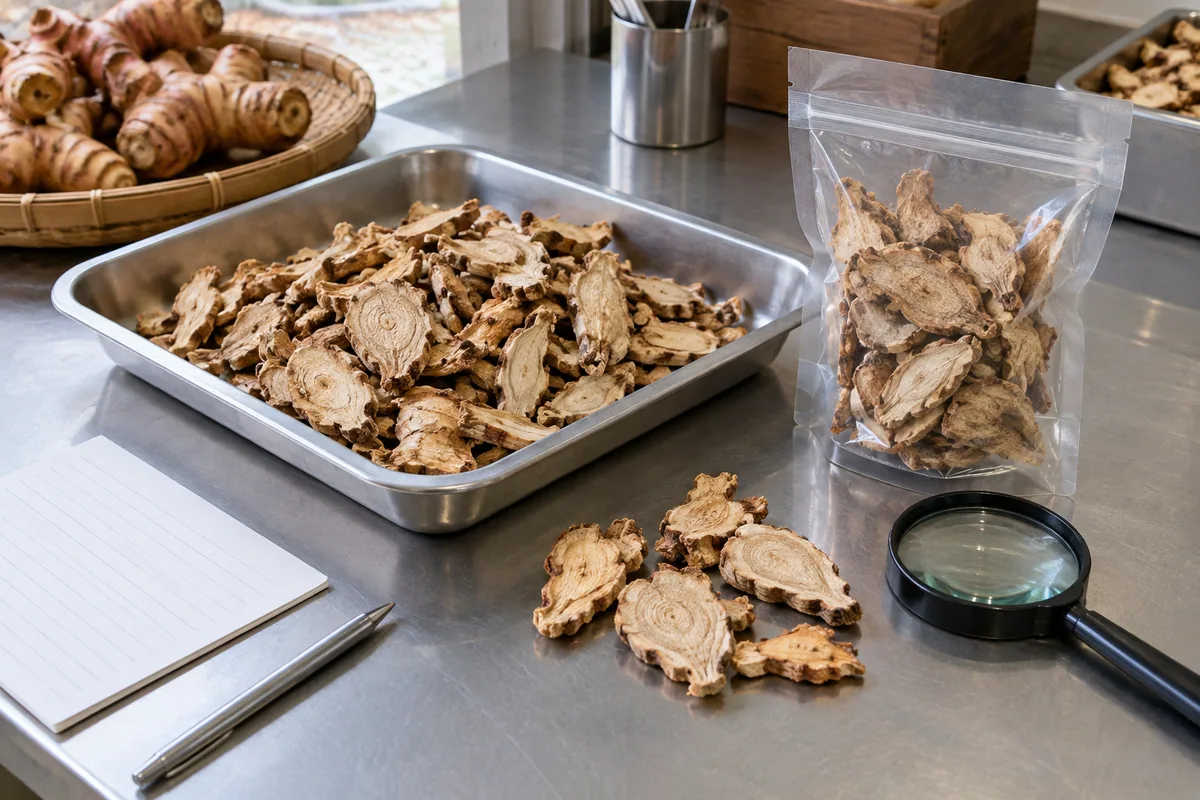
Dried galangal is a low-moisture spice ingredient, but low moisture does not mean zero food-safety risk. Biological hazards can survive in dry products. Chemical hazards can originate in cultivation, processing, storage, treatment, or the environment. Physical hazards can enter from soil, equipment, buildings, packaging, or handling. A buyer needs a control system that matches the product and intended use.
Quality control and food safety overlap, but they are not identical. Cut thickness, color, aroma, and breakage may affect process performance and presentation. Pathogens, pesticide residues, heavy metals, mycotoxins, allergens from cross-contact, and hazardous foreign objects can affect safety or legal compliance. The specification should show which requirements are critical and which are commercial.
This article gives procurement and quality teams a practical framework for dried Alpinia galanga. It uses the Codex hygienic code for spices and dried aromatic herbs as a general reference. The final hazard analysis, limits, sampling, tests, and release plan must follow current law, buyer use, destination, and the verified supplier process.
This control framework applies to both dried galangal slices and whole or chunk dried galangal. Read it with the complete B2B buyer’s guide, the specification-writing guide, and the sample evaluation guide so prevention, measurement, and commercial approval remain connected.
1. Build a Product and Process Description
A hazard review needs a specific product. State botanical name, plant part, origin, dried condition, slices or whole and chunk format, intended use, pack, storage, transport, and whether the buyer applies a later kill step. A generic line such as “dried spice” is too broad for a reliable decision.
Map the actual process from fresh-rhizome receipt through cleaning, preparation, drying, cooling, sorting, packing, storage, and loading. Add any treatment, rework, subcontracted step, or external laboratory. The map should show where material changes status and where lots can be combined or split.
The process description lets the team ask better questions. Soil can enter at harvest. Water can enter during washing. Metal or hard plastic can enter from equipment. Moisture can return during cooling, packing, or transport. Cross-contact can occur where other products or allergens are handled. Each relevant pathway needs a control or a reason it is not applicable.
Buyers can review the fuller processing guide before deciding which supplier records and controls matter.
2. Confirm Botanical Identity and Prevent Mix-Ups
Several plants are called galangal. The specification should use Alpinia galanga when greater galangal is required. Kew lists the species as accepted. Common names such as lengkuas, Java galangal, or Siamese ginger can support communication, but they should not replace the botanical line.
Identity control begins with approved raw-material sources and receiving criteria. Records should connect intake code, supplier or farm reference, processing lot, finished lot, sample, test report, pack, and dispatch. If different botanicals share an area, the supplier should explain identification and separation controls.
Visual inspection alone has limits. Shape, skin, interior, aroma, and color can support a trained review. If the buyer’s risk assessment needs stronger botanical verification, define an appropriate method and qualified provider. The result should refer to the same sample and lot system used for commercial release.
A mix-up is not corrected by passing moisture or microbiology. Identity is a separate acceptance requirement. Hold any uncertain material until the discrepancy is resolved.
3. Review Biological Hazards
Low-moisture foods can carry pathogens and other microorganisms. The exact hazard profile depends on primary production, water, animals, workers, equipment, environment, drying, storage, treatment, and intended use. The buyer’s food-safety team should determine which organisms or indicators require control and verification.
Codex CXC 42-1995 provides general hygienic practice for spices and dried aromatic herbs. It covers considerations across primary production, establishment design, processing, storage, and transportation. Use it as a framework, then apply the actual regulatory and customer requirements for dried galangal.
Testing can verify parts of the system, but absence in a sample does not prove absence in every package. Sample size, number of units, method, laboratory capability, and lot definition affect confidence. A buyer should avoid treating one certificate from a different lot as continuing proof.
If the buyer requires a microbial-reduction treatment, define the permitted method, validation or verification evidence, process disclosure, post-treatment protection, sensory requirements, residues where relevant, and document needs. Do not assume a treatment was applied unless it is agreed and recorded.
4. Review Chemical Hazards and Residues
Chemical review may include pesticide residues, heavy metals, mycotoxins, cleaning chemical residues, treatment residues, environmental contaminants, or other substances identified by the hazard analysis. The relevant list changes with origin, product classification, destination, use, and current regulation.
Pesticide requirements should be precise. Name the regulatory framework or buyer list, applicable commodity classification, maximum residue levels, analytical scope, reporting limits, method, laboratory, and sampling frequency. “EU compliant” is not enough for a laboratory request. The European Commission’s pesticide database is an official reference tool, but the importer should verify classification and current legal application.
Heavy-metal and contaminant limits can also vary by jurisdiction and product category. The buyer or regulatory adviser should confirm which limits apply to dried galangal as imported and used. A limit for ginger, turmeric, supplements, or a ready-to-eat food should not be transferred without justification.
Supplier questionnaires can gather agricultural-input and processing information. Laboratory testing can verify selected risks. Neither should be used alone. Combine source approval, process controls, declarations, risk-based tests, and trend review.
5. Control Physical Hazards and Foreign Material
Physical hazards can include stones, metal, glass, hard plastic, wire, wood, packaging pieces, or other objects capable of causing harm. Foreign matter can also include soil, other plants, fibers, insects, and non-hazardous unwanted material. Define categories because action levels and control methods differ.
The process may use visual sorting, screens, magnets, metal detection, or other controls depending on equipment and product geometry. A device is not automatically effective because it appears on a process flow. Its suitability, sensitivity, placement, monitoring, challenge checks, and response procedure must fit the product and hazard.
Large irregular chunks can behave differently from slices on screens or detectors. Product effect, orientation, pack type, and aperture can influence performance. The supplier should validate or verify the control under actual conditions rather than quote a generic capability.
Inspection records should identify the lot, sample size, categories found, result, and action. Serious hazardous material should trigger hold and investigation, not merely removal from the sample followed by release.
6. Manage Moisture, Water Activity, and Environmental Exposure
Moisture content supports lot comparison and storage control, but it is not a direct universal safety guarantee. The specification should state the method, sample preparation, unit, and limit. Process monitoring and contractual release may use different tools; their relationship should be understood.
Water activity may be useful when the hazard analysis requires it. It measures a different property from moisture content. State the instrument, temperature, calibration, sample conditioning, and limit. Do not convert between moisture and water activity with an unsupported assumption.
Environmental humidity can affect dried galangal after the dryer. Cooling, open transfer, sorting, packing, damaged liners, warehouse conditions, and container condensation can change product condition. Controls should protect the verified lot through dispatch and receiving.
If a pack appears wet, open, or condensed on arrival, isolate it. Record photographs, pack code, location, seal, and surrounding condition. Do not mix compromised packs with acceptable stock while the parties investigate.
7. Prevent Cross-Contact and Allergen Problems
Galangal itself is not a substitute for an allergen-control review. The supplier may handle other products, processing aids, lubricants, cleaning chemicals, or packaging materials that introduce risks. The buyer should ask what shares receiving, storage, cutting, drying, sorting, packing, and transport areas.
If regulated allergens are handled, review scheduling, physical separation, cleaning, line clearance, rework, labeling, and verification. The relevant allergen list depends on destination. A declaration should describe actual handling conditions rather than provide a generic “allergen free” statement without basis.
Cross-contact can also change botanical purity or aroma even when no regulated allergen is involved. Strong spices and chemicals can transfer odor. Other plant fragments can create identity and quality problems. Storage and shared equipment controls should reflect this reality.
Include any required allergen or cross-contact statement in the approved document set. Reconfirm it if the supplier process or product portfolio changes.
8. Define the Lot and Sampling Plan
A lot should represent material produced or handled under defined conditions. State what creates a new lot: intake combination, drying run, date range, treatment run, packing run, or another controlled boundary. The definition should be narrow enough for results and corrective action to be meaningful.
Sampling should cover expected variation. Select packs or locations across the lot. Consider segregation of fines, small pieces, and dense foreign matter. Record increment size, combined sample, laboratory portion, retained portion, sampler, date, and chain of custody.
The plan can follow an applicable standard, regulatory instruction, customer method, or approved internal procedure. Naming a standard is not enough; confirm that the procedure suits the product, lot size, parameter, and laboratory portion.
When the buyer or inspection company samples, responsibilities for access, sealing, transport, and delay should be agreed. When the supplier samples, the buyer should know how representativeness is protected.
9. Choose Laboratories and Methods Carefully
Use a laboratory with appropriate competence for the method and matrix. Accreditation scope can be relevant, but the buyer should check whether the specific test is covered and whether the reporting limit is suitable for the legal or customer limit.
The test request should identify product, sample code, lot, analytes, methods, limits, units, reporting needs, and recipient. Vague requests increase the chance of a panel that cannot answer the acceptance question.
Review the report beyond the pass mark. Check names, dates, sample condition, method, unit, result, quantification or detection limit, comments, subcontracting, and authorization. Resolve transcription and identity errors before release.
Trend results across lots when enough data exists. A value moving toward a limit can prompt preventive action even before failure. Trend review should use comparable methods and sample bases.
10. Create a Clear Release and Failure Process
Release should require completion of the defined evidence: inspection, tests, pack checks, document review, quantity, and lot identity. State who has authority to release. Commercial urgency should not override a critical hold.
When a result is outside specification, secure the lot and investigate. Check sample identity, method, equipment, process records, other results, and scope. Retesting may be justified for a documented reason, but repeated testing to obtain a passing result weakens the system.
Define the possible decisions: rework, retreatment where allowed, resampling where justified, concession approved by the buyer, downgrade, return, destruction, or rejection. Food-safety and legal limits may not permit concession. The responsible technical team must decide.
Notify the buyer according to the agreement. Provide facts, affected lot, current status, investigation plan, and proposed action. Avoid conclusions before evidence is available. Record corrective and preventive actions when the root cause is confirmed.
11. Control Packing, Storage, and Transportation
Use food-compatible inner packaging and an outer pack that protects the chosen format. Verify liner closure, cleanliness, damage, net weight, labels, and pallet condition. Store finished product in a clean, dry, pest-controlled area away from water and strong odors.
Inspect the container or transport unit before loading. Check dryness, cleanliness, odor, structural condition, and suitability. Record loading order, pack count, lot, seal where used, and transfer under the agreed Incoterm.
Transport conditions should be considered in the product risk assessment. Long routes, climate changes, ventilation choices, and container condition can affect condensation risk. No single packaging statement removes the need for route-specific planning.
The packing and storage article provides a detailed operational checklist.
12. Review Supplier Performance Over Time
Approval is not a one-time badge. Monitor lot conformance, complaints, document accuracy, response time, deviations, test trends, trace exercises, and change notifications. The review frequency should follow risk and performance.
Require notice of material changes that can affect the approved basis. Examples include new origin, new processing site, new dryer, new treatment, new pack, new laboratory, new subcontractor, or changed lot definition. Decide whether documents, samples, tests, or audits must be repeated.
Use problems to improve the system. A complaint should connect receiving evidence, retained samples, production records, shipment records, and investigation. Corrective action should address cause, not only replace product.
The objective is consistent decision quality. A supplier with transparent evidence and disciplined response can be easier to manage than one that promises perfection without showing how lots are controlled.
Buyer Food-Safety File Checklist
- Product and process description for dried Alpinia galanga.
- Intended use, consumer or process context, and any later kill step.
- Supplier identity, location, scope, approvals, and change-notification agreement.
- Hazard analysis covering biological, chemical, physical, cross-contact, and authenticity risks.
- Process flow and relevant preventive or prerequisite controls.
- Written specification with critical and commercial criteria separated.
- Lot definition and traceability from intake through finished pack.
- Sampling plans for physical, chemical, and microbiological verification.
- Approved laboratories, methods, reporting limits, and decision rules.
- Treatment details and evidence where a microbial-reduction step is required.
- Packing, storage, pest-control, transport-unit, and loading controls.
- Release authority, deviation, retest, rework, concession, and rejection procedures.
- Complaint, recall, mock trace, corrective action, and performance-review records.
Frequently Asked Questions
Is dried galangal safe because it has low moisture?
Low moisture can limit growth of many microorganisms, but pathogens may survive in low-moisture foods. Chemical and physical hazards also remain possible. Safety depends on a product-specific control and verification system.
Does every shipment need microbiological testing?
Frequency should follow current legal requirements, buyer policy, hazard analysis, process controls, supplier performance, and the commercial agreement. Testing does not replace prevention or representative sampling.
Can a buyer rely on a supplier certificate of analysis?
The certificate is one evidence item. Review sample and lot identity, method, laboratory, units, limits, dates, and chain of custody. Combine it with supplier controls, physical inspection, packing records, traceability, and destination requirements.
Is steam treatment always required?
No universal treatment requirement applies to every buyer and use. The need depends on hazard analysis, intended use, later processing, law, customer standard, and target results. If treatment is required, approve the method and evidence in writing.
How can I begin a quality discussion with PT Tri Global Export?
Review the quality page and send the format, application, destination, required tests, and known limits through the contact page. The final scope and current-lot evidence must be confirmed in writing.
Sources and Verification
- Codex CXC 42-1995 for hygienic practice for spices and dried aromatic herbs.
- Kew Plants of the World Online: Alpinia galanga for accepted botanical identity.
- FDA FSVP final rule overview for United States importer verification context.
- European Commission official controls and EU Pesticides Database for current EU reference tools.
This article is educational and is not legal advice, a food-safety plan, an audit report, or a guarantee. Qualified personnel must confirm the applicable hazard analysis, law, methods, and lot evidence.
Prepared for buyer education. Product, test, document, availability, price, and destination requirements remain subject to written verification for the relevant order and lot.