
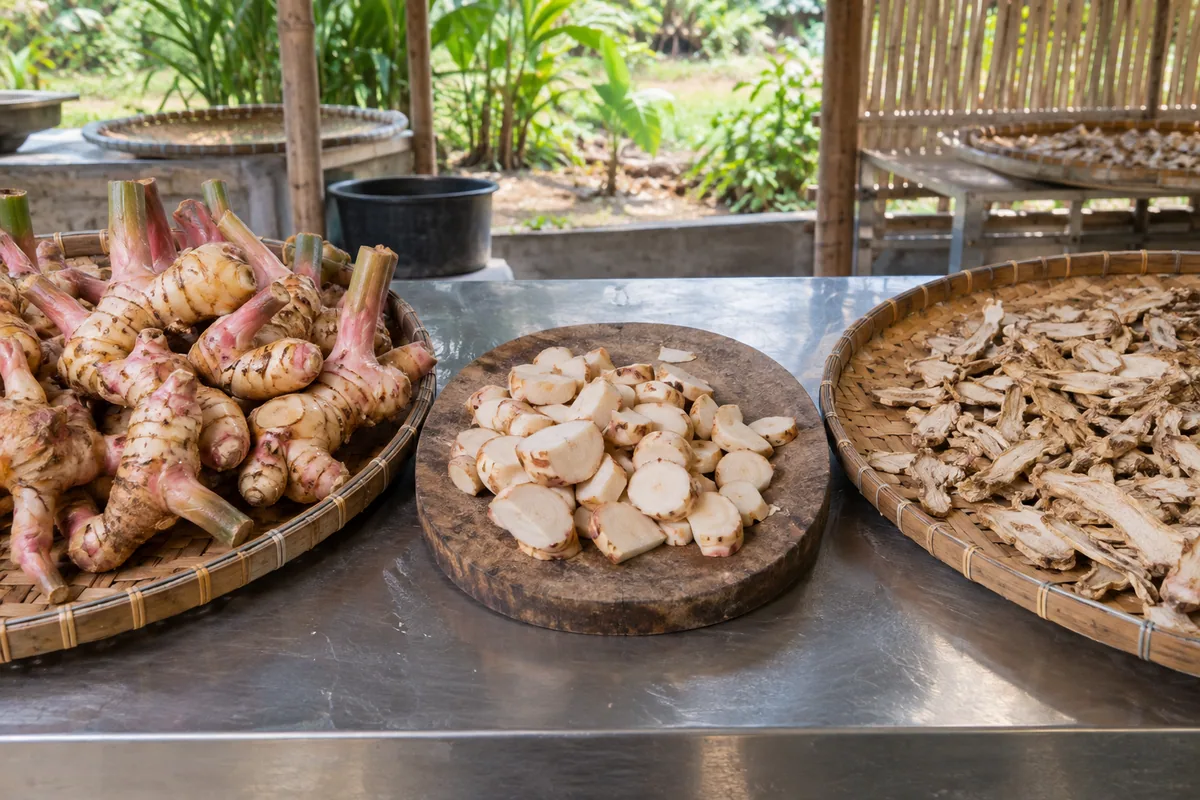
Fresh galangal does not become a stable B2B ingredient through one drying step. The commercial result is shaped by raw-material identity, receiving, cleaning, cutting or piece preparation, drying, sorting, packing, storage, sampling, and release. A change at any stage can affect appearance, moisture distribution, breakage, aroma, foreign matter, and the relationship between a test result and the shipped lot.
Buyers do not need to control the supplier’s daily operations. They do need to understand the process well enough to write a specification and decide what evidence matters. A clear process flow helps the buyer identify where a requirement is created, where it can change, and where it should be checked.
This article presents a practical processing model for dried Alpinia galanga from Indonesia. It does not claim that every producer uses identical equipment or sequence. The actual route, controls, and records should be confirmed for the supplier and order under review.
1. Receive and Identify Fresh Rhizomes
Processing begins before washing or cutting. The receiving team needs a defined material description, supplier or farm reference, receipt date, quantity, and lot or intake code. The botanical requirement should be Alpinia galanga when greater galangal is the intended product. Kew recognizes this as an accepted species and records Java and Sumatra within its native range.
Common names are useful for conversation but weak as the only identity control. Lengkuas, greater galangal, Java galangal, and Siamese ginger can refer to the intended species in different markets. Other species also carry the word galangal. The receiving description should therefore include botanical name, plant part, origin, and expected fresh appearance.
Initial inspection can identify visible decay, excessive soil, foreign plant material, pest damage, or a condition that does not fit the receiving requirement. The decision rule should state whether material is accepted, separated, held for review, or rejected. Recording only the accepted material hides useful information about supplier performance and process yield.
Traceability starts here. The intake code should remain connected to the dried production lot or to a documented combination of intakes. If lots are combined, the records should explain the relationship. This connection allows a later question about a carton or test sample to move backward through the process without relying on memory.
2. Remove Soil and Unwanted Material
Galangal is a rhizome and arrives from the soil environment. Cleaning must remove soil and unwanted material without creating a new contamination or moisture problem. The actual method may include dry removal, trimming, washing, rinsing, draining, or a sequence of steps. The supplier should describe the method used for the relevant product.
Water quality, equipment condition, cleaning frequency, employee practices, drainage, and separation between dirty and cleaned material can affect the result. A visually clean rhizome is not proof of a hygienic process, but visible soil remaining after preparation is a clear physical concern. The buyer’s foreign-matter definition should distinguish soil, stones, plant material, packaging fragments, and other categories where needed.
Cleaning also affects drying. Added surface water must be considered before material enters a dryer or drying area. Uneven draining can create different starting conditions. The process should avoid cleaned material waiting in a warm, wet state longer than the validated or controlled route allows.
Buyers can ask for the cleaning flow, water control where water is used, foreign-matter checks, and the action taken when material does not meet the pre-drying condition. The objective is a clear control story, not a decorative process photograph.
3. Prepare Slices or Larger Pieces
Format preparation determines much of the visible product. For slices, the process needs a target cut direction and thickness, an acceptable distribution, and a rule for off-size pieces. Blade condition, feed orientation, equipment setting, and natural rhizome shape can all create variation. A buyer should approve a realistic range rather than expect every agricultural slice to be identical.
For whole and chunk material, the preparation step may involve trimming, separating branches, or defining larger pieces. “Whole” does not mean that handling can never create breakage. The supplier and buyer should define how complete rhizomes, large branches, chunks, and smaller broken material are categorized.
Cutting increases exposed surface. This can change drying rate, handling behavior, aroma exposure, and the amount of small material created. Large pieces dry differently because moisture has farther to move from internal areas. The process should match the geometry that will actually be packed.
Physical hazards also need attention at this stage. The supplier’s hazard analysis should consider equipment condition, preventive maintenance, tool accountability, and relevant foreign-material controls. The buyer does not need to prescribe a universal device. The buyer should verify that the control is appropriate to the actual process and product.
4. Dry to a Defined and Verifiable Condition
Drying reduces water, but a commercial requirement should not be described only as “fully dried.” The process needs a target endpoint, a method for monitoring the run, and a lot release test or inspection that relates to the agreed specification. Time and temperature can be process inputs, while moisture and other properties are product outcomes.
The correct conditions depend on piece size, loading depth, airflow, equipment, ambient conditions, and the required product profile. A copied drying time is not reliable across all systems. Thick slices and large chunks can need different controls. Overloading or uneven distribution can create zones that dry at different rates.
Drying also influences color, aroma, texture, and brittleness. Aggressive conditions may not produce the same sensory result as a gentler route. Slow or poorly controlled drying can create other concerns. The buyer should specify the required product attributes and let the validated process create them, rather than choosing a temperature without understanding the system.
Moisture testing should use an agreed method, prepared sample, unit, and limit. If the buyer also needs water activity, treat it as a separate measure. Record the sample identity and the production lot. A number without that link is not reliable release evidence.
5. Cool and Protect the Dried Material
Material leaving a drying step may be warmer than the surrounding area. Packing it before the condition is suitable can create condensation or uneven moisture within the pack. The process should define how dried galangal cools, how long it may wait, and how it is protected from humidity, pests, dust, odor, and mix-up during that period.
Cooling areas and containers should be clean and appropriate for food material. Open exposure should be limited to what the process requires. The supplier should prevent contact between finished dried material and fresh, dirty, rejected, or differently identified material.
This stage can be overlooked because no dramatic transformation occurs. In practice, it protects the work completed during drying. A sound moisture result can be undermined if the product absorbs humidity before packing. A clean product can be compromised by an uncovered transfer.
Buyer review should ask where the dried material goes next, how status is identified, and what protects it before sorting and packing. Simple controls can be effective when they are consistent and recorded.
6. Sort, Grade, and Control Foreign Material
Sorting turns a broad production output into the format described in the specification. The team may remove off-size pieces, excessive fines, visible defects, foreign material, or pieces that do not match the approved condition. The method can be manual, mechanical, or combined. The important point is that the output is checked against measurable criteria.
A marketing grade such as premium does not tell the buyer what was removed or what variation remains. A useful grade identifies attributes, tolerance, sampling, and decision rules. For slices, these may include thickness distribution, breakage, fines, color reference, and foreign matter. For whole and chunk material, they may include piece categories and smaller broken material.
Sorting has a yield cost. A tighter tolerance removes more product from the accepted fraction or requires more labor. That cost should be visible in quotation discussions. The buyer can then decide whether the tighter range improves process value enough to justify it.
The rejected or downgraded material must remain separated from accepted material. Rework should follow a defined route. Records should identify the result of the inspection and the quantity released to packing. This is how the final pack quantity connects to the process lot.
7. Sample and Verify the Lot
Verification should occur against a defined lot and written requirement. Physical inspection, moisture testing, sensory review, microbiological testing, chemical testing, or application trials may be included depending on risk, destination, and buyer use. No single panel is correct for every order.
Sampling is the bridge between the lot and the result. The plan should define how many packs or locations are sampled, how increments are combined, how the laboratory portion is prepared, and whether a retained sample is kept. A sophisticated test cannot correct a biased or unidentified sample.
The result should state the parameter, method, unit, limit, actual result, sample identity, lot identity, date, and decision. If an external laboratory is used, record the laboratory report reference. If an internal inspection is used, record the responsible function and controlled form.
Out-of-specification results need a pre-agreed response. Hold the lot while the issue is reviewed. Decide whether investigation, justified retesting, rework, concession, downgrade, or rejection applies. Do not release material first and explain the failed evidence later. The quality control article covers this system in more detail.
8. Pack and Identify the Finished Product
Packing should protect the verified condition. The inner food-contact layer, closure, outer pack, net weight, and pallet configuration should match the specification. The pack must suit the format. Thin slices, small fragments, and irregular chunks place different stresses on liners and cartons.
Each finished unit should carry the agreed identity information. Typical fields can include product name, botanical name where required, format, lot or batch code, net weight, production or packing date, origin, and handling instructions. The exact label must follow the buyer’s use and applicable destination rules. Do not add claims that are not supported.
Weight control needs a defined method and tolerance. The filling process should avoid systematic underweight and unnecessary overfill. The final count of units and net weight should match the packing list and commercial documents.
Pack inspection can cover liner closure, outer-pack integrity, cleanliness, marking, pallet condition, and count. Photographs can support the dispatch record. They should show the actual order or identified lot when used as evidence, not a generic staged pack.
9. Store and Load Without Losing Control
Finished dried galangal should remain in a dry, clean, pest-controlled location with lot status visible. Packs should be protected from water, floor contact where inappropriate, strong odors, damage, and unauthorized mixing. Stock rotation should follow the documented product and buyer requirement.
Storage condition affects any shelf-life statement. A reliable shelf life must connect product, pack, storage, test plan, and end-of-life specification. It should not be copied from another dried spice. Buyers should request the evidence behind the stated period and confirm whether it applies after the pack is opened.
Before loading, inspect the cargo and transport unit. Check cleanliness, dryness, odor, visible damage, and suitability for the planned load. Confirm pack count, pallet count, lot identity, and seal procedure where a seal is used. Record who transfers responsibility under the agreed Incoterm.
Loading evidence should be proportionate to risk. A practical file may include pack photographs, lot release record, loading photographs, seal reference, packing list, and transport document. The packing and storage guide gives the buyer and warehouse team a fuller checklist.
10. Build Traceability Through Every Stage
Traceability is not a statement that everything is traceable. It is the ability to connect a finished pack to records that explain its material and process history. The chain begins with intake identity and continues through preparation, drying, sorting, testing, packing, storage, and dispatch.
Each transformation needs a recorded relationship. If several fresh intakes become one drying lot, record the combination. If one drying lot is split between formats or customers, record the outputs. If rework is added, record its origin and authorization. If labels are replaced, preserve the original and new identity link.
A mock trace can test whether the system works. Select a finished lot and ask the team to identify relevant inputs, processing records, checks, pack quantities, and dispatch. Then move forward from an intake to its finished destinations. Gaps discovered during a mock exercise are less costly than gaps discovered during a complaint.
Buyers can ask for a traceability explanation without requesting confidential farm or supplier details in public content. The commercial agreement can define what information is disclosed, when it is disclosed, and how confidentiality is protected.
Buyer Audit Questions
Use these questions during a desktop review, sample qualification, or supplier discussion:
- How is fresh Alpinia galanga identified and coded at receiving?
- What cleaning steps are used, and how are water and dirty-to-clean movement controlled?
- How are slice thickness or whole and chunk piece categories defined?
- Which process variables are monitored during drying, and how is the endpoint verified?
- How is dried material protected during cooling, transfer, and waiting?
- Which defects, size fractions, and foreign materials are removed during sorting?
- How is a test sample linked to the represented lot and finished packs?
- Which release checks are fixed, and which are added for the buyer or destination?
- What happens when an inspection or result falls outside specification?
- How are inner liners, closures, net weight, labels, and outer packs checked?
- How are lots separated and identified in finished-product storage?
- Can the supplier trace a finished pack backward and a raw intake forward?
These questions should produce specific answers and records. A process description is useful when it explains the real controls, not when it uses broad claims such as world class, premium, or export standard.
Frequently Asked Questions
Is dried galangal always sliced before drying?
No. The preparation sequence depends on the intended format and controlled process. Slices require a cutting step, while whole or chunk material uses a larger piece route. The buyer should confirm the actual flow and how the chosen geometry reaches the moisture and quality requirement.
Does lower moisture always mean better quality?
No. Moisture should meet an agreed limit and method that supports product stability, handling, route, and application. Excessively aggressive drying can affect other attributes. The correct target balances the full specification rather than maximizing one number.
Can sun drying be accepted for a commercial order?
Acceptance depends on the buyer’s hazard analysis, product specification, destination rules, actual process controls, environmental protection, monitoring, and evidence. The label “sun dried” or “mechanically dried” is not enough by itself. Review how contamination, weather, time, temperature, and moisture endpoint are controlled.
Why is a lot code important?
A lot code connects the pack to process, inspection, test, and dispatch records. Without that link, a result may describe a sample but not the product received. Lot identity also supports focused investigation and action if a later issue occurs.
Where should a buyer begin?
Begin with the application and format. Review the dried galangal slices versus whole and chunk guide, then write the critical attributes in a dried galangal specification. Send the starting brief through the contact page.
Sources and Verification
- Kew Plants of the World Online: Alpinia galanga for botanical identity and distribution.
- Codex CXC 42-1995 for general hygienic principles covering primary production, processing, packing, storage, and transportation of spices and dried aromatic herbs.
- PT Tri Global Export product pages for the two commercial format routes discussed on this site.
This processing guide is educational. It does not certify a facility, prescribe one mandatory technology, or guarantee a lot. Confirm the actual process, hazard controls, specification, sampling, evidence, and release decision for each order.
Prepared for buyer education. Product, test, document, availability, price, and destination requirements remain subject to written verification for the relevant order and lot.