
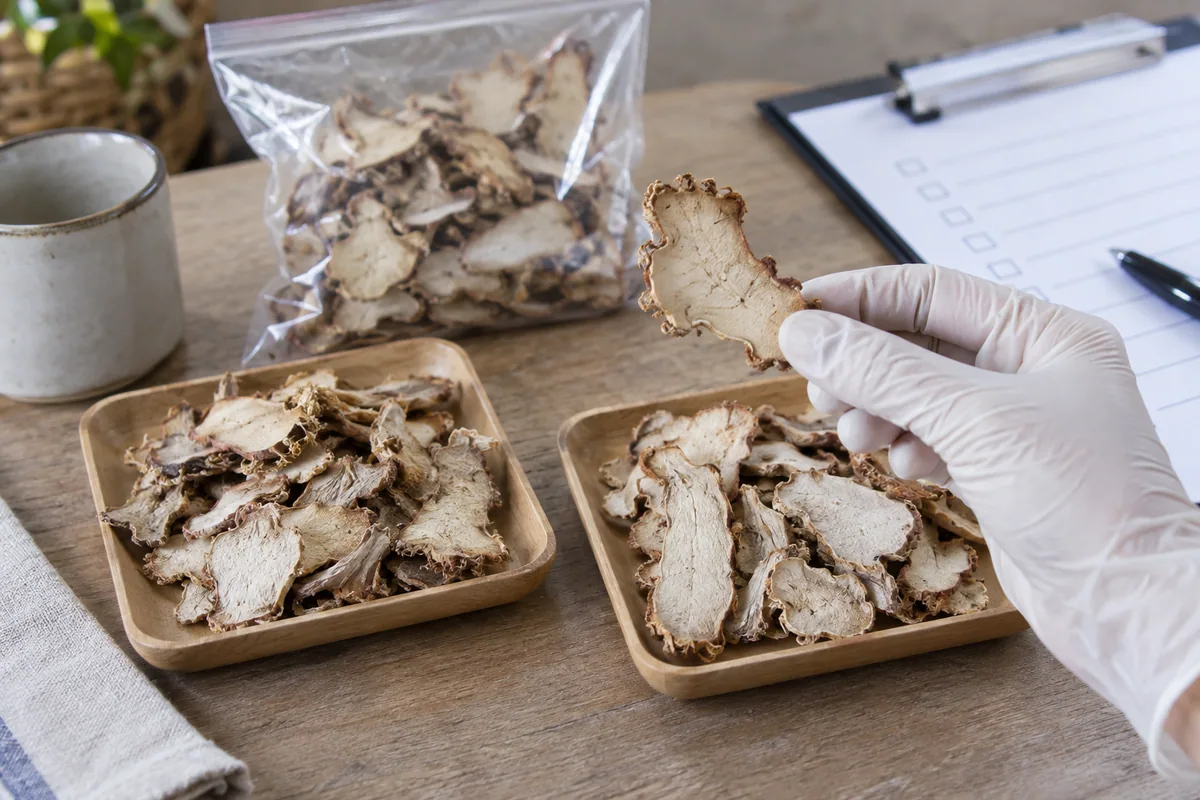
A dried galangal sample can answer useful questions before a commercial order, but only when the sample has a defined purpose. A small pouch may demonstrate general product type. It may represent a production target, a recent production run, or a specific available lot. Those are different kinds of evidence. A buyer who approves the material without recording which kind was reviewed can create a false sense of certainty.
A good sample review connects three things: the physical material, the written specification, and the buyer’s actual application. Visual inspection alone is not enough. Laboratory results alone are not enough. An application trial alone is not enough. Together, with clear identity and records, they can support a practical qualification decision.
This guide provides a repeatable workflow for dried Alpinia galanga slices and whole or chunk material. The exact tests and acceptance limits must come from the buyer’s use, risk assessment, destination, and approved specification.
Before ordering samples, compare the two commercial routes on the dried galangal products page. Use that format choice to decide how much sample is needed and which physical checks will be meaningful.
1. Identify the Sample Before Opening It
Record the supplier, product name, botanical name, format, origin, sample code, lot code if available, production or packing date, dispatch date, receipt date, pack type, and stated representativeness. Photograph the unopened pack and label. This creates a basic chain of identity before material is moved or divided.
Ask the supplier to classify the sample. An indicative sample shows the general product concept. A target sample shows the condition the supplier proposes to reproduce. A current-lot sample is drawn from a defined lot that may be allocated or offered. A shipment sample is linked to product already packed or ready for release. The commercial value of approval depends on the category.
Check the package for damage, opening, wetting, odor transfer, missing identification, or excessive delay. Courier conditions can affect a small sample more than a commercial pack. If the sample arrives compromised, record the issue and request a replacement rather than forcing a pass or fail decision.
Do not let an attractive presentation override identity. A clean pouch and printed label do not prove botanical or lot relationship. The evidence begins with a traceable sample code and a written supplier statement about what it represents.
2. Prepare a Consistent Review Area
Use a clean, odor-free area with neutral lighting and a plain surface. Strong colored light can distort the appearance of dried rhizomes. Perfume, coffee, cleaning chemicals, and other spices can interfere with aroma review. Keep unrelated materials away from the sample.
Allow the sample to reach the planned review condition if it has been exposed to unusual temperature, but keep it protected from uncontrolled humidity. Record any conditioning step. Do not leave an open sample on a desk for hours and then treat its moisture or aroma as the arrival condition.
Use clean trays and tools. If a sample will be sent for microbiological testing, follow an appropriate aseptic sampling and handling procedure rather than using the portion handled for visual review. Separate portions before reviewers touch or smell the material closely.
Write the sequence before starting. For example: arrival inspection, sample division, visual assessment, physical measurements, sensory review, laboratory dispatch, application trial, retained portion, and final decision. A fixed sequence reduces accidental bias and loss of evidence.
3. Confirm the Product and Format
Check that the sample is described as dried Alpinia galanga rhizome when that is the required product. Kew recognizes Alpinia galanga as an accepted species, but a buyer still needs supplier evidence and appropriate controls because common names can overlap with other plants.
Confirm whether the sample is slices or whole and chunk material. For slices, note cut direction, apparent thickness, diameter variation, broken pieces, and fines. For whole and chunk material, note the distribution of complete branches, larger sections, smaller chunks, and broken material.
Compare the physical format with the intended process. A sample can meet a supplier’s description but still be wrong for the buyer’s mill, infuser, blender, extractor, or visible presentation. Record operational suitability separately from conformance to the proposed specification.
If identity remains uncertain, do not approve based on appearance. Ask the buyer’s technical team to define the appropriate botanical verification route. Photographs and aroma can support review but should not be treated as definitive identification by unqualified reviewers.
4. Review Color and Surface Condition
Spread the material in a single layer and observe a representative portion. Record the range rather than choosing the best pieces. Note exterior color, cut-face color, discoloration, scorching, visible decay, mold-like growth, excessive soil, or unexpected surface material.
Natural agricultural variation is expected. The purpose is not to demand uniform factory color. The purpose is to define which variation is acceptable for the application and which condition indicates a defect or possible process problem. Use agreed names and photographs for defect categories.
Compare the sample with a controlled reference if one exists. Use the same lighting and background. Record the date and reference code. If the reference is old or has been stored differently, acknowledge that limitation rather than making a precise color claim.
Avoid approving an image instead of the material. Camera exposure, white balance, screen settings, and compression can change perceived color. Supplier photographs are useful for orientation and lot review, but physical approval should rely on the received sample and written criteria.
5. Measure Cut, Pieces, Breakage, and Fines
For slices, select pieces according to the written sampling rule and measure thickness with a suitable tool. Record the distribution, not only an average. An average can hide a mixture of very thin and very thick pieces that behave differently in an infusion or dryer.
Define broken pieces and fines before counting or weighing them. A small but usable slice should not move between categories depending on who inspects it. If sieves are used, specify opening size, sample mass, shaking procedure, time, and calculation. If visual categories are used, provide examples.
For whole and chunk material, measure or classify enough pieces to describe the distribution. Consider whether the buyer’s equipment can accept the largest piece and whether the smallest fraction remains useful. Open some larger pieces when internal condition is relevant to the review.
Record the result in the same unit and format used by the specification. A note that says “size looks good” cannot support later receiving inspection. A table with category, method, result, and decision can.
6. Check Aroma and Foreign Odor
Evaluate aroma in a controlled and safe way. Reviewers can note whether the sample has the characteristic profile expected from the approved reference and whether any musty, smoky, chemical, rancid, or other objectionable foreign odor is present. Use simple language that different teams can understand.
Sensory intensity changes with piece size, temperature, age, and how the sample is handled. Breaking or milling a piece can release more aroma than smelling an intact piece. If the method includes crushing, record it and use the same method for future comparisons.
Do not use aroma to prove safety or botanical identity. It is a quality and application observation. If a foreign odor suggests contamination or poor storage, hold the sample and investigate rather than trying to mask or average the result.
Application teams may need a blind comparison with the current approved ingredient. Coding samples can reduce brand and price bias. Record the preparation, dose, time, temperature, and scoring method.
7. Inspect Cleanliness and Foreign Matter
Examine a defined quantity under suitable light. Separate and identify visible soil, stones, other plant material, fibers, plastic, metal, glass, insects, or other unwanted matter. High-risk items should trigger the action defined by the hazard analysis, even if their weight percentage is small.
Use the specification’s definitions. Some systems distinguish extraneous matter from foreign matter or classify unintended parts of the same plant separately. The names and calculations must match the agreed method.
Inspect the bottom of the sample container because small dense particles and fines can settle during transport. Mix or divide the sample according to the procedure before drawing conclusions. A photograph of the top layer can miss the fraction most relevant to cleanliness.
Record both result and action. If the sample fails, ask whether the condition represents the process, lot, courier damage, or sample preparation. Do not quietly remove unwanted material and continue as if the original sample conformed.
8. Plan Moisture and Other Analytical Tests
Moisture testing needs an identified sample portion, appropriate preparation, agreed method, unit, and limit. Keep the analytical portion sealed until preparation. Small samples can gain or lose moisture quickly after opening, especially in humid conditions.
Decide which laboratory tests are needed before requesting the sample quantity. Microbiological, pesticide, heavy-metal, mycotoxin, volatile-oil, ash, and identity work can require different portions, containers, and handling. The buyer’s hazard analysis and destination review should determine the panel.
Laboratory results describe the submitted portion. Review the report for sample name, sample code, lot, method, result, unit, reporting limit, date, and laboratory identity. Resolve inconsistent names before using the report for approval.
If the sample is only indicative, an acceptable laboratory result does not automatically release a future lot. State what must be repeated or verified on the commercial material. The dried galangal quality control guide explains this evidence chain.
9. Run an Application Trial
The application trial answers whether the material works in the buyer’s process. Design a small method that represents the intended use. An infusion trial can control dose, water, time, temperature, agitation, filtration, color, aroma, and sensory outcome. A milling trial can control feed size, equipment setting, throughput, heat, screen, and particle distribution.
Use the same procedure for comparison samples. Record every relevant condition. A result such as “stronger flavor” is difficult to reproduce if dose or extraction time changed. Simple controlled notes create better learning than a complex unrecorded demonstration.
Consider yield and handling. Note dust, fines, bridging, slow wetting, filter loading, residue, and cleanup. These operational effects can matter more than the purchase price difference between formats.
Decide what the application approval controls. It may approve the sample as a formulation reference, confirm the selected format, or set a minimum performance expectation. Link that decision to the sample code and specification.
10. Record Approval, Conditions, and Open Points
The final review should show pass, conditional pass, hold, or fail for each category. A conditional pass might require a changed cut tolerance, additional current-lot test, different liner, or new sample. List every condition and responsible party.
Do not combine serious failures into an average score. Botanical identity, prohibited contamination, a critical safety requirement, and a commercial appearance preference have different consequences. The decision matrix should reflect risk and contract significance.
If several departments participate, collect one coordinated decision. Procurement, quality assurance, product development, regulatory, and production may view the same sample differently. Record conflicts and resolve them before the purchase order.
Send the supplier a controlled summary. Confirm what was approved, what was not approved, what the sample represented, and what evidence is required for the commercial lot. This prevents approval from being remembered as broader than it was.
11. Retain the Sample Correctly
Divide and seal a retained portion before repeated handling when practical. Label it with product, supplier, sample code, lot, receipt date, retention date, specification revision, and reviewer. Store it under conditions that protect it from moisture, odor, pests, light, and mix-up.
Define a retention period based on the qualification program and product stability. A retained agricultural sample will change. It can lose aroma, absorb moisture, darken, or become damaged. Record storage and do not assume the sample remains an exact visual standard forever.
If a commercial lot is approved, retain a shipment-linked portion according to the agreement. This may support later investigation, but it must have a credible sampling and identity link. An unsealed handful kept after packing has weak evidentiary value.
Control sample disposal so an obsolete sample is not accidentally used for a new approval. Mark superseded references and document replacement.
12. Connect the Sample to the Commercial Order
The purchase order or specification should reference the approved sample code and explain its role. State which attributes are controlled by the sample, which are controlled by numerical limits, and which will be verified again on the commercial lot.
Ask whether the offered lot is the sampled lot. If not, define the supplier’s responsibility to reproduce the approved target and provide lot-specific evidence. Agricultural variation makes this distinction important. A target sample is useful, but it is not a physical guarantee that every future piece will match.
Before release, review the lot inspection, test results, pack evidence, and document set against the same approved file. Do not create one standard for sample approval and a second informal standard for shipment.
For a complete order sequence, return to the B2B buyer’s guide and use the specification-writing guide to document the outcome.
Sample Evaluation Checklist
- Identify supplier, botanical name, format, origin, sample code, lot, dates, and sample category.
- Photograph and inspect the unopened sample pack.
- Prepare clean, neutral, odor-free review conditions.
- Divide visual, analytical, application, and retained portions before handling.
- Confirm format and suitability for the next process.
- Record color range, surface condition, defects, and reference comparison.
- Measure size distribution, breakage, and fines with a defined method.
- Evaluate characteristic aroma and any foreign odor consistently.
- Separate and classify foreign matter from a representative quantity.
- Send the correct identified portion for agreed laboratory work.
- Run a controlled application trial with recorded conditions.
- Record pass, conditional pass, hold, or fail for every critical category.
- Link approval and open points to the specification revision.
- Define what must be verified again on the commercial lot.
Frequently Asked Questions
How large should a dried galangal sample be?
The required quantity depends on the number of reviewers, physical measurements, laboratory panels, application trial, and retained portion. Ask each function for its need before shipment. The supplier should confirm current availability, courier cost, and whether the sample represents a lot.
Can a buyer approve from photographs?
Photographs support orientation and lot review, but they do not provide aroma, moisture, tactile condition, internal view, analytical results, or application performance. They are also affected by lighting and camera settings. Use physical and analytical evidence where those characteristics matter.
Should the buyer pay for a sample?
Sample price, preparation, testing, and courier arrangements are commercial terms. There is no universal rule. Confirm the amount, representativeness, cost allocation, and shipping responsibility before dispatch.
Does an approved sample guarantee identical future lots?
No agricultural material is perfectly identical. Approval should define acceptable variation and the evidence required for each commercial lot. A supplier can work toward the approved target, while the specification provides measurable boundaries.
How do I request a sample from PT Tri Global Export?
Use the contact page and state the format, application, destination, required tests, sample quantity, and whether you need an indicative or current-lot sample. Availability and terms will be confirmed in writing.
Sources and Verification
- Kew Plants of the World Online: Alpinia galanga for accepted botanical identity.
- Codex CXC 42-1995 for hygienic principles and the importance of controls across handling and processing of spices and dried aromatic herbs.
- PT Tri Global Export quality page for the site’s current sample and written-specification approach.
This guide is educational. It does not replace qualified botanical identification, food-safety assessment, laboratory advice, destination review, or an approved commercial specification.
Prepared for buyer education. Product, test, document, availability, price, and destination requirements remain subject to written verification for the relevant order and lot.