
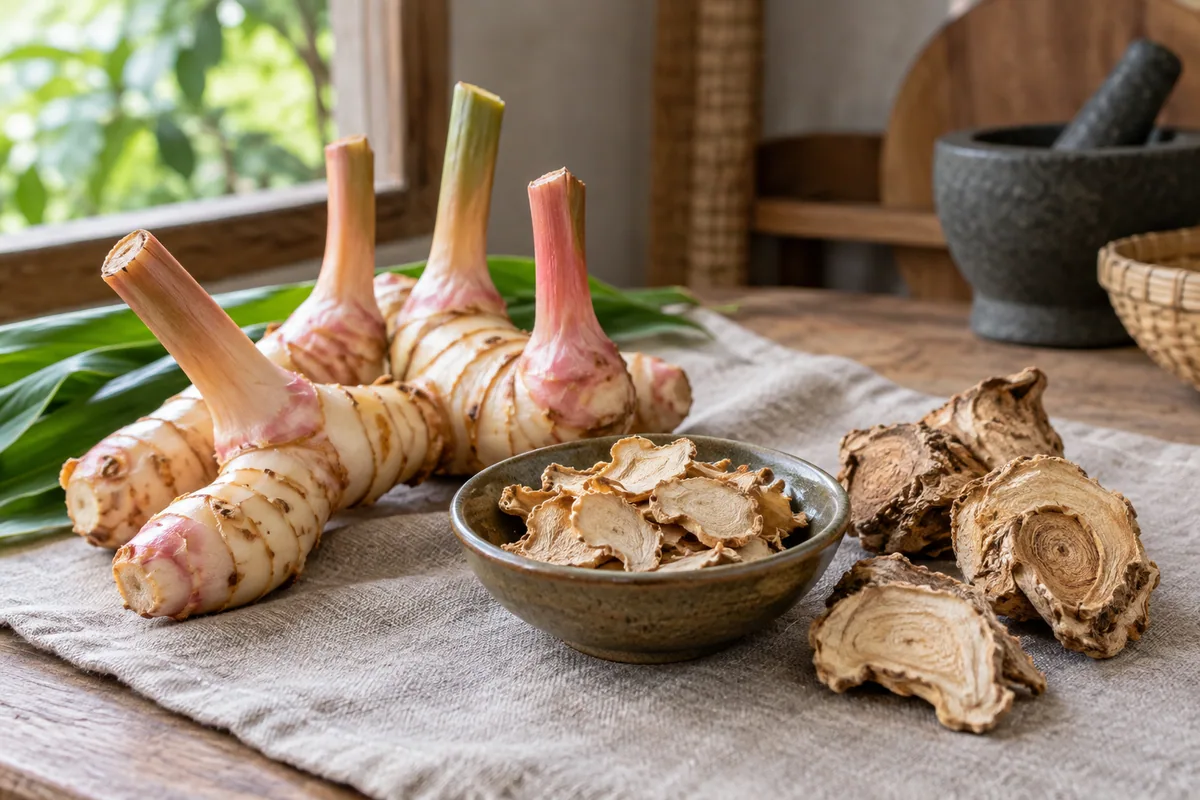
What is galangal? Galangal is the aromatic rhizome of several plants in the ginger family, but the name does not identify one species by itself. The product supplied by Lanka is greater galangal, Alpinia galanga. It is called lengkuas in Indonesia and is used as a food ingredient for its piney, citrus-like, peppery aroma and firm rhizome character. Fresh and dried galangal are related ingredients, but they do not behave exactly the same in a recipe or manufacturing process.
This guide explains greater galangal in plain language. It covers botanical identity, flavor, traditional culinary uses, dried formats, and common food applications. It also explains why buyers should not confuse culinary history with proof of a medical benefit. The goal is to help chefs, product developers, importers, and ingredient buyers describe the material they actually need.
1. Galangal Is a Rhizome, Not a Root in the Botanical Sense
People often call galangal a root because the edible part grows below the soil and looks root-like. Botanically, it is a rhizome: a modified underground stem that stores energy and can produce shoots. The commercial phrase “galangal root” is common and understandable, but a technical specification should name the plant part as rhizome.
Greater galangal belongs to the Zingiberaceae family, which also includes ginger, turmeric, and cardamom. Family membership explains some visual similarities, but it does not make these ingredients interchangeable. Galangal is typically firmer and more fibrous than culinary ginger. Its aroma is also distinct. A formula created around fresh ginger cannot be converted to galangal by changing only the name.
The accepted botanical name used across Lanka product pages is Alpinia galanga (L.) Willd. Kew Plants of the World Online lists Alpinia galanga as an accepted species and records a native range that includes Java and Sumatra. That reference supports identity and distribution. It does not define a commercial grade, processing method, or quality promise for a shipment.
For B2B purchasing, write “dried Alpinia galanga rhizome” before adding the cut, moisture target, packing, and other order-specific requirements. This simple naming practice prevents many misunderstandings.
2. Greater Galangal Is Not Every Plant Called Galangal
Several different plants are sold under names that contain the word galangal. Greater galangal is Alpinia galanga. Lesser galangal is commonly associated with Alpinia officinarum. Aromatic ginger or kencur is Kaempferia galanga. These are separate botanical species with different sensory profiles, customary uses, and research records.
This distinction matters in search results. An article may say “galangal” in its headline while the study itself tested Kaempferia galanga, Alpinia officinarum, an isolated chemical, or a proprietary extract. A conclusion about one of those materials cannot automatically be applied to ordinary dried Alpinia galanga. Buyers should read the species, plant part, preparation, and dose in the original research before using it to support a product decision.
Common names also vary by country and language. “Thai ginger,” “Siamese ginger,” “Java galangal,” and “lengkuas” may help people recognize the category, but none should replace the botanical name in a purchase specification. A photograph alone is also insufficient because lighting, age, cutting, and drying can change appearance.
Ask the supplier to connect the botanical identity to the physical sample, lot record, and commercial documents. That link is more useful than a long list of loosely related common names.
3. What Does Galangal Taste and Smell Like?
Galangal flavor is often described as peppery, bright, woody, resinous, pine-like, and lightly citrus-like. Those words are orientation terms, not a universal sensory specification. Perception changes with the cultivar, growing conditions, rhizome maturity, cleaning, drying, storage, cut size, extraction medium, contact time, temperature, and the other ingredients in a formula.
Compared with ginger, greater galangal is usually experienced as less juicy and more woody or camphor-like. Compared with turmeric, it lacks turmeric’s familiar yellow color and earthy profile. The aroma can read as fresh and sharp in one broth but warmer and more subdued in a dried seasoning blend. Fat, water, alcohol, acidity, and heat do not extract every aromatic component in the same way.
Modern aroma research can identify volatile compounds and evaluate which ones contribute to odor, but a chemical list does not replace sensory testing. A 2025 study of greater galangal used instrumental and sensory approaches to characterize important aroma compounds. The open-access report is available through PubMed Central. Its findings help explain why galangal has a complex aroma rather than one simple flavor note.
For product development, evaluate a representative lot in the intended recipe. Record the amount, particle size, liquid or fat system, temperature, contact time, and evaluation method. This creates a reproducible flavor decision instead of relying only on adjectives.
4. Fresh Galangal and Dried Galangal Are Not Direct Substitutes
Fresh galangal contains water and has a crisp, dense structure. It may be sliced, bruised, grated, or pounded depending on the dish. Dried galangal has lost much of that water, so its mass, texture, aroma release, and handling behavior are different. Drying can preserve useful aromatic character while also changing the balance of volatile and nonvolatile components.
There is no dependable universal rule that one gram of dried galangal always replaces a fixed number of grams of fresh galangal. Drying method, final moisture, slice thickness, storage age, and recipe conditions all affect intensity. A practical conversion begins with a controlled kitchen or pilot trial. Adjust the dried material to reach the target sensory profile, then document the result for the specific lot and formula.
Dried slices can be easier to weigh, store, transport, and remove after simmering. Larger dried pieces are useful when a processor wants to mill or extract in-house. Ground galangal disperses differently and exposes more surface area, but it also loses visible identity and may release aroma faster. Each format has a valid use.
The detailed guide on how to use dried galangal gives practical preparation methods. For commercial selection, compare dried galangal slices with whole and chunk material before choosing a format.
5. Traditional Culinary Uses of Galangal
Greater galangal has a long culinary history in Southeast Asian food traditions. It appears in aromatic pastes, soups, broths, braises, sauces, marinades, and spice mixtures. In Indonesia, lengkuas is commonly combined with other aromatics to build depth rather than used as a single dominant flavor. In Thai cooking, galangal is familiar in aromatic soups and curry pastes. Recipes vary widely by region, household, and product style.
Traditional use tells us that people have learned to handle the ingredient in food. It does not establish that every preparation has the same composition or that eating it produces a specific health outcome. A fresh rhizome pounded into a paste, a dried slice simmered in broth, an essential oil, and a concentrated laboratory extract are materially different preparations.
For translation-friendly product communication, describe the actual function. Say “used to add a peppery, woody aroma to broths” or “intended for further blending.” Avoid vague statements such as “ancient healing spice” when the commercial product is offered as a food ingredient. That wording can confuse culinary history with a medical claim.
Buyers developing a traditional-style food should work with a knowledgeable formulator or culinary specialist. The supplier can define the raw material and its evidence. The buyer remains responsible for the final recipe, label, serving conditions, and destination compliance.
6. Common Food and Beverage Applications
Dried galangal can support several application directions when the format fits the process. Slices may be simmered in soups, stocks, and sauces, then removed or strained. They can be included in botanical infusion blends when the formulation and destination rules allow it. Ground material may be used in dry seasonings, pastes, marinades, or extraction programs after the buyer confirms particle size and flavor performance.
Food manufacturers should begin with the desired sensory outcome. Is the galangal meant to lead the aroma, support another spice, or provide a background note? Does the consumer see the ingredient, or is it removed before packing? Will it enter water, oil, alcohol, or a mixed system? How long is the heat step? These questions determine whether a visible slice, a large piece, or a milled form is practical.
Galangal can also be evaluated for flavor extracts, but extraction is not one single operation. Solvent, temperature, time, particle size, ratio, agitation, and downstream concentration affect the result. A supplier of dried rhizome should not promise an extraction yield without a defined method and representative testing.
For buyers who want a ready-cut format, see dried galangal slices. Buyers with suitable size-reduction equipment can review whole and chunk dried galangal. Both routes need a written specification and a representative sample.
7. Dried Slices, Whole or Chunk, and Powder Serve Different Jobs
Dried slices make the cut visible. A buyer can inspect thickness, diameter range, broken pieces, surface color, and fines. This is helpful for products where appearance matters or where repeatable infusion behavior is a target. Slice production adds cutting and sorting steps, so the commercial basis may differ from larger pieces.
Whole or chunk material keeps more size reduction under the buyer’s control. It can suit extractors, millers, and processors with defined equipment. The word “whole” must still be clarified because dried rhizomes can separate or break naturally. A useful specification describes the expected piece profile and acceptable smaller material.
Powder offers convenience but changes the evidence available to the receiving buyer. Visual identity is harder to assess after milling, the exposed surface area increases, and particle-size distribution becomes important. If a buyer purchases powder, the specification should address identity, mesh or particle-size method, packaging, and the relevant safety controls. Lanka’s current core offer focuses on slices and whole or chunk material rather than presenting a universal powder grade.
Format choice should follow the process. It should not be treated as a quality ranking. A clean large piece is not automatically better than a clean slice, and a thin slice is not automatically more potent. The B2B buyer’s guide explains how format fits into the broader order decision.
8. How Drying and Storage Affect the Ingredient
Drying reduces water and changes the physical material. It also creates a new set of controls. The processor must manage cleaning, cut size where applicable, drying conditions, final moisture, sorting, packing, and storage. Uneven pieces may dry at different rates. Excessive heat or time can change color and aroma. Insufficient drying or later moisture gain can create storage problems.
Research comparing drying techniques shows why “dried” is not a complete process description. A study indexed by PubMed evaluated how drying methods affected Alpinia galanga quality characteristics. See the drying-technique study record. Such research provides useful process context, but it does not certify a supplier’s current lot. Current-lot evidence must come from the actual production and agreed test plan.
After drying, packaging should limit moisture pickup, contamination, odor transfer, and physical loss. Storage conditions matter because dried botanicals can still change over time. A fixed shelf-life statement requires evidence tied to the material, pack, storage conditions, and end-of-life limits. It should not be copied from another spice.
The packing and storage guide covers liners, outer packs, labels, pallets, container checks, receiving, and shelf-life verification in more detail.
9. Traditional Uses and Potential Benefits Need Careful Language
People search for galangal benefits because the plant has a history of traditional use and because laboratory research has examined its extracts and compounds. These are valid subjects to discuss, but the evidence must be described at the correct level. Traditional use records cultural practice. Laboratory activity shows what happened under a defined experimental condition. Animal research can explore mechanisms. A human trial tests a specific preparation, population, dose, outcome, and period.
None of those layers automatically proves that ordinary dried galangal slices prevent, treat, or cure disease. A proprietary extract may be concentrated or standardized in a way that a food ingredient is not. A compound isolated in a laboratory is not the same as a serving of soup. An antioxidant assay in a test tube is not a clinical outcome.
Lanka supplies dried Alpinia galanga as a food-sector ingredient subject to written specification and lot evidence. It is not presented as medicine. Buyers making finished foods or supplements must review their own formulation, evidence, labeling, and destination rules.
For a detailed evidence ladder, read potential galangal benefits: what research does and does not show. That guide discusses laboratory, animal, and limited human findings without turning them into product promises.
10. What Buyers Should Put in a Galangal Specification
A commercial description should start with Alpinia galanga rhizome, dried condition, origin, and required format. Then add the attributes that affect the buyer’s process: slice thickness or piece profile, visible condition, odor, foreign matter, moisture, packing, and any relevant chemical or microbiological criteria.
Every number should have a unit and test method. Every sample should have an identity and purpose. State whether the sample is indicative, representative of current production, or tied to the offered lot. Decide which characteristics are controlled by a physical sample and which are controlled by analytical limits.
The specification should also state the intended use and any regulatory status the buyer requires. A supplier cannot infer whether a botanical will be used as a conventional food, an infusion ingredient, a flavor preparation, or another regulated category in the destination market. Classification can affect documents, testing, and labeling.
Use the dried galangal specification guide to build a measurable order basis. Then use the sample evaluation guide to connect the paper requirements with actual material.
11. How to Evaluate Galangal for a New Recipe or Product
Start with a small, recorded trial. Identify the sample and format. Weigh the material. Record whether it is used whole, broken, ground, steeped, simmered, or blended. Note the liquid or food matrix, temperature, contact time, removal or filtration step, and final batch size.
Evaluate aroma before and after processing. Record when the galangal becomes noticeable, whether the profile is balanced, and whether woody or bitter notes appear with longer contact. Compare at least two levels when possible. A single trial can tell you that a recipe works, but it cannot show where the useful range begins or ends.
For scale-up, compare surface area and mixing, not only mass. A larger vessel can heat and circulate differently from a kitchen pot. A mill may produce a broad particle distribution. Extraction time may change. Use the pilot result as a starting point, then confirm the commercial process.
Keep health evaluation separate from flavor evaluation. A pleasant aromatic result does not prove a physiological effect, and a laboratory paper does not determine the best recipe. Define the product objective first, then choose the evidence relevant to that objective.
12. Frequently Asked Questions About Galangal
Is galangal the same as ginger?
No. Greater galangal and ginger are different species in the same plant family. Their texture and aroma differ, so they should be evaluated separately in a recipe. Read the galangal versus ginger guide for a manufacturing-focused comparison.
Can dried galangal be used in tea or an infusion?
It can be evaluated as a botanical infusion ingredient where the formulation and destination rules permit it. Use a controlled steeping trial, strain the material where appropriate, and do not attach a medical promise to the drink without substantiation and regulatory review.
Can I eat dried galangal slices directly?
Dried slices are firm and fibrous. They are commonly used for simmering, steeping, grinding, or further processing rather than eaten as a snack. The safe and suitable use depends on the finished-food process and applicable requirements.
Which format has the strongest flavor?
There is no universal answer. Surface area, moisture, drying history, storage, amount, and preparation method affect aroma release. Compare representative formats under the same recipe conditions.
Does galangal have proven health benefits?
Research exists on extracts, isolated compounds, laboratory systems, animals, and a limited number of specific human preparations. That evidence does not establish that ordinary dried galangal produces a particular clinical benefit. Treat disease-related claims as a separate scientific and regulatory question.
Sources and Verification
- Kew Plants of the World Online: Alpinia galanga for accepted botanical identity and recorded distribution.
- PubMed Central: aroma-active compounds in greater galangal for recent analytical and sensory characterization of aroma.
- PubMed: effects of drying techniques on galangal quality for process-related research context.
- FDA: Label Claims for Conventional Foods and Dietary Supplements for the distinction among types of claims in the United States.
This article provides food-ingredient and buyer education. It is not medical advice, a disease claim, a product guarantee, or a substitute for regulatory review. Confirm identity, specification, intended use, evidence, and destination requirements for the actual product and lot.
Prepared for buyer education. Product, test, document, availability, price, and destination requirements remain subject to written verification for the relevant order and lot.