
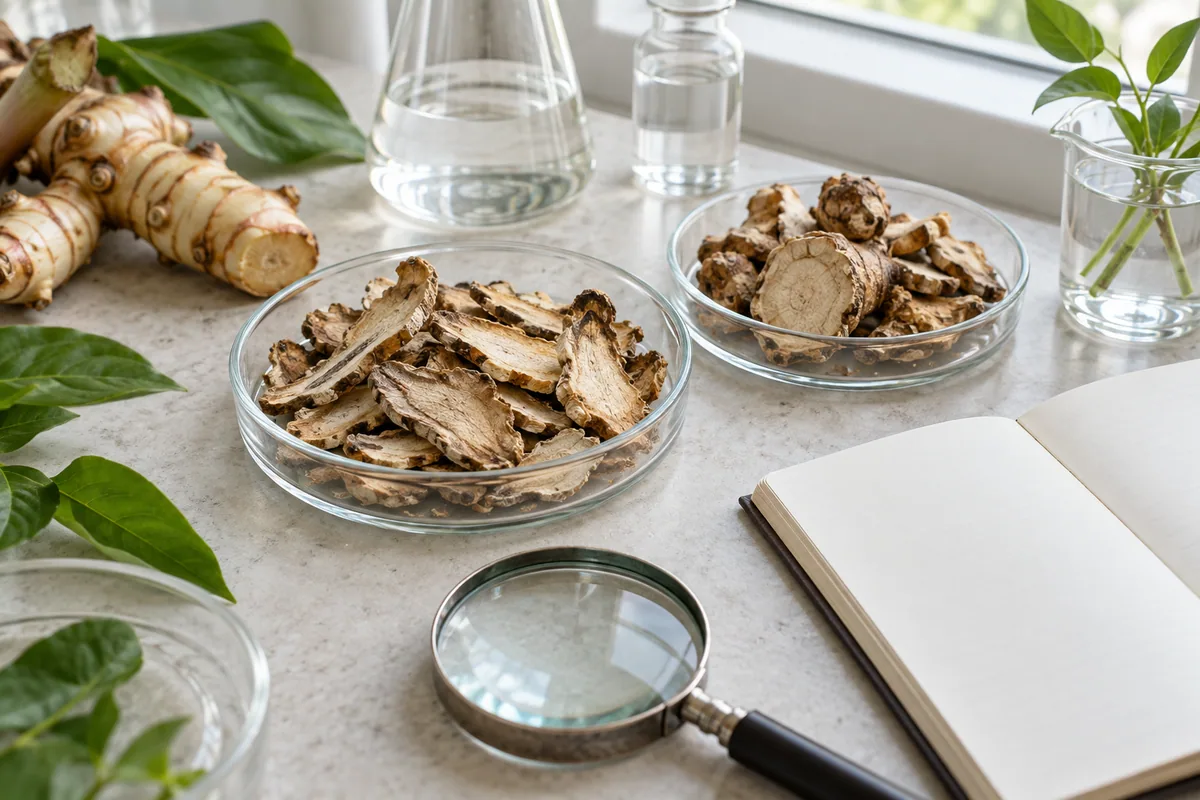
Searches for galangal benefits often produce confident lists: antioxidant, antimicrobial, anti-inflammatory, digestive, cognitive, or sexual-health support. The scientific record is more complicated. Research on Alpinia galanga includes chemical analysis, laboratory assays, animal models, and a small number of human studies using specific extracts. Those categories do not provide the same level of evidence, and they do not automatically describe ordinary dried galangal used in food.
This guide explains what the research can and cannot support. It keeps greater galangal separate from other species called galangal. It also separates a dried food ingredient from essential oil, isolated compounds, solvent extracts, and proprietary standardized preparations. That distinction is essential for accurate product development and responsible marketing.
1. First Confirm Which Galangal the Research Studied
The word galangal is not a complete scientific identity. Greater galangal is Alpinia galanga. Lesser galangal is commonly associated with Alpinia officinarum. Kencur or aromatic ginger is Kaempferia galanga. Research on one species should not be cited as proof for another.
Plant part matters too. A paper may study the rhizome, leaf, seed, flower, or essential oil. Lanka’s product category is dried Alpinia galanga rhizome. Findings from a leaf extract cannot be transferred to the rhizome without evidence. Even within the rhizome category, fresh material, dried slices, powder, steam-distilled oil, ethanol extract, water extract, and purified compounds are not equivalent.
The Kew record for Alpinia galanga supports the accepted botanical identity. A responsible research review then checks the species name in the methods, not only in the article title or search-result summary.
Buyers can use the introduction What Is Galangal? to understand the ingredient and its common food roles before interpreting potential benefits.
2. Use an Evidence Ladder Instead of a Benefit List
An evidence ladder helps readers understand how close a finding is to a real human outcome. Chemical identification shows what investigators detected in a sample. A test-tube assay shows activity under defined laboratory conditions. Cell research explores effects in a cultured cell system. Animal studies can examine mechanisms and safety signals in a living organism. Human observational research looks for associations. Controlled human trials test a defined intervention and outcome.
Moving upward does not make the lower levels useless. Laboratory research can guide hypotheses and identify compounds worth studying. Animal work can help researchers design later trials. The problem begins when an early-stage finding is presented as a settled consumer benefit.
A useful review asks five questions: What exact material was tested? How was it prepared? What amount was used? Who or what received it? What outcome was measured? If those details do not match the commercial ingredient and intended use, the finding may be interesting but not directly applicable.
No single study should carry more certainty than its design allows. Replication, sample size, controls, duration, consistency, safety reporting, and total evidence all matter.
3. Traditional Use Is Context, Not Clinical Proof
Greater galangal has a long history in food and traditional practice across parts of Asia. Traditional knowledge can identify culturally important preparations and research questions. It can also explain why people continue to use an ingredient in soups, pastes, infusions, or household preparations.
Traditional use alone does not demonstrate clinical efficacy. Practices may differ in species, plant part, preparation, amount, frequency, and purpose. A traditional water preparation is not the same as a concentrated solvent extract. Historical use also does not remove the need to study interactions, vulnerable populations, or the safety of concentrated products.
The most accurate consumer wording is descriptive. “Traditionally used in aromatic food preparations” is different from “clinically proven to treat digestive disease.” The first statement describes use. The second is a medical claim that needs strong, product-relevant evidence and regulatory authorization where applicable.
For Lanka, the defensible role is dried galangal as a food-sector ingredient supplied against a written specification. The company should not turn cultural history into a promise that the shipped material will produce a health outcome.
4. What Bioactive Compounds Have Researchers Examined?
Researchers have identified volatile aroma compounds, phenolic constituents, flavonoid-related measurements, and compounds such as acetoxychavicol acetate in preparations of Alpinia galanga. The exact profile depends on the sample, origin, maturity, processing, storage, and extraction method. A detected compound is not automatically present at the same level in every commercial lot.
Volatile compounds help explain galangal’s sensory character. Recent analytical and sensory work has examined aroma-active substances rather than treating galangal as one undifferentiated odor. See the open-access greater galangal aroma study. This type of research is highly relevant to flavor understanding, but it does not establish a disease-related benefit.
Nonvolatile constituents and isolated compounds are often studied because they show activity in experimental systems. When a paper names one compound, check whether the investigators used the whole rhizome, an extract enriched in that compound, or the purified substance. Concentration changes exposure.
A commercial buyer who needs a chemical marker should define the method, limit, sample basis, and reason in the specification. It is not enough to copy a compound name from a review article and assume the supplier’s food ingredient has a standardized level.
5. What “Antioxidant Activity” Means in Laboratory Research
Antioxidant assays can measure how a sample behaves toward a chemical radical, reducing system, or oxidation model under laboratory conditions. Results may be reported using assays such as DPPH, ABTS, FRAP, or related methods. These methods are not interchangeable, and the result can change with the solvent, concentration, and calculation basis.
A 2024 Alpinia galanga rhizome study examined phytochemical content and antioxidant activity along with antibacterial tests and cancer-cell experiments. The PubMed record describes an extract-based laboratory study. It is evidence that the tested extract produced measurable responses under those methods. It is not evidence that dried galangal cures cancer, prevents chronic disease, or creates the same response after digestion.
Human physiology is more complex than a chemical assay. Digestion, absorption, metabolism, dose, tissue exposure, and interactions determine what happens after consumption. An ingredient can perform strongly in a test tube and still lack demonstrated clinical benefit.
Therefore, “contains compounds studied for antioxidant activity” is more accurate than “is a powerful antioxidant that prevents disease.” Finished-product claims require a separate evaluation of the total evidence and applicable labeling rules.
6. What Antibacterial and Antifungal Studies Do Not Prove
Laboratory studies have exposed microorganisms to Alpinia galanga extracts, essential oils, or isolated compounds and measured inhibition under controlled conditions. An older study, for example, investigated acetoxychavicol acetate as an antifungal component. The PubMed study record describes the tested material and laboratory context.
This does not mean ordinary dried galangal sterilizes food, treats an infection, or replaces a validated preservation system. The concentration used in a laboratory well may be much higher than what is practical in a recipe. The extract may not behave the same in fat, protein, starch, or a complex food matrix. A result against one organism does not establish control of every relevant pathogen or spoilage organism.
Food manufacturers must continue to use a documented hazard analysis and validated controls. Heat treatment, pH, water activity, refrigeration, sanitation, packaging, and other hurdles should not be reduced because a botanical showed in vitro antimicrobial activity.
Consumers should not use a supplier article to self-treat a bacterial or fungal infection. Clinical diagnosis and treatment belong with qualified health professionals. The research is a lead for further study, not a substitute for care.
7. What Cell and Animal Research Can Tell Us
Cell studies can show whether a preparation affects viability, signaling, oxidation, or another measured process in a particular cell line. Animal studies can explore absorption, metabolism, organ effects, behavior, or disease models. These designs can support biological plausibility, but they do not establish a human benefit by themselves.
The tested concentration may be impossible to reach through normal food use. The route may be injection or a concentrated oral preparation rather than a culinary serving. Animal metabolism and the experimental disease model may differ from human conditions. Positive findings require replication and appropriately designed clinical research.
Cancer-cell results are especially easy to overstate. Activity in a cultured cancer cell line does not mean a food treats cancer. Many substances can affect cells at sufficient concentrations, including concentrations that would not be safe or achievable in people. Only clinical evidence and regulatory review can support a treatment claim.
Animal safety findings also have limits. Absence of an observed problem in one short animal study does not prove safety for every person, dose, extract, medication combination, or duration. Concentrated preparations need product-specific safety assessment.
8. What Limited Human Studies Have Examined
Human research on Alpinia galanga is limited compared with the breadth of online benefit claims. One randomized, double-blind, placebo-controlled crossover study enrolled 59 adults with habitual caffeine intake. It tested a proprietary Alpinia galanga extract, caffeine, their combination, and placebo for short-term alertness and attention outcomes. The details are in the PubMed record for the 2017 trial.
That study does not show that dried galangal slices have the same effect. The intervention was a named proprietary extract, the population was selected, and the measured period was short. The result would need replication and cannot be converted into a culinary use amount.
A 2023 triple-blind trial enrolled 60 adult men who were taking selective serotonin reuptake inhibitors and experiencing erectile dysfunction. It compared a specified Alpinia galanga extract with placebo over four weeks. The PubMed record for that trial reports a promising result while calling for further evidence.
Again, this was a narrow clinical context using an extract. It does not support marketing Lanka’s dried food ingredient for sexual function, and nobody should change prescribed medication or self-treat on this basis. A clinician must manage medication-related effects.
9. Why Extract Studies Cannot Be Applied Directly to Dried Slices
An extract selectively moves compounds from plant material into a solvent. The result depends on solvent type, temperature, time, particle size, material-to-solvent ratio, filtration, concentration, and standardization. A proprietary extract may be manufactured to contain a target marker. Dried slices are the unextracted food material.
Two preparations with the same species name can deliver very different exposures. Eating a small amount in soup, drinking a mild water infusion, taking a concentrated capsule, and receiving an isolated compound are not equivalent. The body may absorb each preparation differently, and the safety profile can change with concentration.
This is why a human trial cannot be translated into a supplier claim unless the commercial product matches the studied preparation and the claim is supported under the destination rules. Matching requires more than the botanical name. It includes composition, manufacturing, dose, population, use conditions, and outcome.
If a buyer plans to manufacture an extract, the buyer should validate the extraction process and finished formulation. Lanka can define the raw dried material and lot evidence, but it should not imply that its slices or chunks reproduce a published proprietary extract.
10. Is There a Proven Galangal Dose for Health Benefits?
There is no universal therapeutic dose established for ordinary dried Alpinia galanga food material. Published studies use different preparations and research objectives. A dose from one extract cannot be converted safely into a number of dried slices without composition and pharmacokinetic evidence.
Culinary use is a flavor-formulation question. Use the method in How to Use Dried Galangal to establish a sensory amount for a food or beverage. That amount should not be described as a dose that prevents or treats disease.
Concentrated supplements raise additional questions about identity, standardization, contaminants, interactions, contraindications, and labeling. People who are pregnant or nursing, taking medication, managing a medical condition, preparing a product for children, or considering high-dose extracts should seek qualified medical and regulatory advice.
“Natural” does not mean risk-free, and a history of food use does not prove that every concentrated preparation is safe at every amount. Product-specific assessment is the responsible route.
11. How Health-Claim Rules Affect Food Marketing
In the United States, food and supplement labeling distinguishes among categories such as health claims, nutrient-content claims, and structure or function claims. Disease-related claims receive particular regulatory scrutiny. The FDA overview of label claims explains these categories and the different requirements.
Other countries use their own rules. A statement allowed in one market may be restricted or require authorization in another. Translation does not remove the legal effect of a claim. Social media, product pages, brochures, packaging, and sales messages can all contribute to how a product is represented.
Responsible copy should match the evidence. It can describe flavor, format, botanical identity, and intended food applications. It can summarize research with clear qualifiers. It should not promise prevention, treatment, or cure without the required substantiation and authorization.
Buyers should ask regulatory specialists to review the finished-product claim, not only the raw-material page. The finished formulation, serving size, consumer population, jurisdiction, and presentation determine the assessment.
12. A Practical Research Checklist for Buyers and Formulators
When evaluating a claim about galangal benefits, use a structured checklist:
- Confirm that the species is Alpinia galanga, not another plant called galangal.
- Confirm the plant part and whether it was fresh, dried, powdered, distilled, extracted, or isolated.
- Record the extraction solvent, standardization, and amount where available.
- Identify whether the evidence is chemical, laboratory, cell, animal, observational, or controlled human research.
- Check the sample size, population, duration, comparator, outcomes, and limitations.
- Look for independent replication and systematic assessment rather than one favorable paper.
- Compare the studied preparation with the commercial ingredient and intended serving.
- Review adverse-event reporting, interactions, contraindications, and vulnerable populations.
- Ask whether the proposed wording is permitted in the destination market.
- Keep flavor claims, traditional-use statements, and disease claims in separate evidence files.
This checklist protects both buyer and supplier. It allows interesting research to be discussed without converting uncertainty into a sales promise.
13. What Lanka Can Responsibly Say About Its Product
Lanka can state that it supplies dried Alpinia galanga rhizome in slices and whole or chunk formats. It can describe the material’s aromatic food use, processing basis, written specifications, packing, sample review, and current-lot evidence when those points are verified.
Lanka should not say that its dried galangal cures inflammation, fights infection in the body, prevents cancer, improves sexual function, boosts cognition, or guarantees another health result. The cited studies do not test Lanka’s ordinary dried product as supplied, and several use extracts or laboratory models.
A buyer can review dried galangal slices or whole and chunk dried galangal for format information. The food-safety and quality-control guide explains the evidence needed for the commercial lot. These are appropriate, verifiable product discussions.
If a buyer intends to develop a health-positioned finished product, the buyer should provide the proposed market, category, formulation, serving, and claim for independent scientific and regulatory review. Raw-material supply does not complete that work.
14. What About Digestion, Nausea, and Stomach Comfort?
Online summaries often group galangal with ginger and repeat digestive or anti-nausea claims. That shortcut is unreliable. Ginger and greater galangal are different botanical species, and evidence for a ginger preparation does not prove the same effect for Alpinia galanga. Even within one species, an extract, fresh rhizome, dried slice, and finished beverage are different interventions.
A traditional digestive use can be described as history when the source is reliable and the wording makes the limit clear. It should not be rewritten as “clinically proven to relieve nausea” unless appropriate human trials tested the relevant product and outcome. Search-result repetition is not independent confirmation; many pages may trace back to one review, one animal experiment, or a study on another plant.
Food use still has practical value without a medical promise. Galangal can add a warm, peppery, citrus-like aroma to a broth or infusion. A consumer may enjoy that sensory experience. Enjoyment and hydration are ordinary product attributes, but they do not demonstrate treatment of indigestion, ulcers, reflux, or nausea.
People with persistent gastrointestinal symptoms should seek qualified medical advice. A food ingredient should not delay diagnosis or replace recommended care. A finished beverage company must review safety, evidence, and labeling for its actual formulation.
15. What About Inflammation and Pain Claims?
Researchers use the word inflammation in many different ways. A laboratory study may measure one enzyme, signaling molecule, or cellular response. An animal study may use an induced model. A clinical study may measure symptoms, biomarkers, function, or medication use in people. These outcomes are not interchangeable.
Reviews of plants in the Alpinia genus can include several species and multiple extract types. A favorable result for Alpinia officinarum, Alpinia zerumbet, or another plant should not be attributed to Alpinia galanga. A result from purified acetoxychavicol acetate also cannot describe the effect of a culinary slice unless exposure and clinical relevance are established.
The most careful conclusion is that experimental research has examined inflammatory pathways involving Alpinia preparations, while human evidence for ordinary dried greater galangal remains insufficient for treatment claims. This wording preserves the scientific interest without telling a reader that the food will relieve arthritis, pain, or another inflammatory condition.
A buyer developing a regulated health product should commission a structured literature review with predefined inclusion criteria. The review should separate species, preparations, outcomes, and risk of bias. Marketing language should be written only after that assessment and a jurisdiction-specific regulatory review.
16. Product Variability Changes How Research Applies
Galangal is an agricultural material. Its chemical and sensory profile can vary with genetics, growing location, soil, weather, maturity, harvest handling, cleaning, cutting, drying, and storage. A research sample from one origin and season is not a universal representation of every commercial lot.
Extraction adds another layer of variability. Water, ethanol, other solvents, distillation, temperature, time, and concentration recover different groups of compounds. Researchers may normalize results to dry weight, extract weight, volume, or a marker compound. Two numbers that look similar may use different denominators.
Commercial evidence therefore needs traceability. A test report should identify the lot, sample, method, units, and date. If a finished product depends on a marker or functional endpoint, the buyer must define that requirement and validate the relationship between the raw material and finished process. A generic certificate or a study PDF cannot substitute for current-lot data.
The dried galangal sample evaluation guide explains how to retain and compare physical references. The specification guide explains how to record test methods and decision limits. Together, they help buyers distinguish research context from shipment acceptance.
17. Safety, Interactions, and Vulnerable Groups
A familiar culinary history does not answer every safety question. Normal food use, repeated high intake, essential oil, and concentrated extract use create different exposures. A study that reports no serious event over a few hours or weeks cannot prove lifetime safety or safety for every population.
Potential interaction questions are especially important when a person takes prescription medication, uses several supplements, or has liver, kidney, bleeding, metabolic, or other health concerns. This article does not establish that galangal causes or avoids any particular interaction. It explains why absence of a warning on a food page should not be interpreted as evidence of compatibility.
Pregnant or nursing people, children, older adults, and people preparing for a procedure may require individual professional guidance before using concentrated botanical preparations. Allergy or sensitivity is also possible with foods and spices. Stop using a product and seek appropriate care if a concerning reaction occurs.
Manufacturers need a safety assessment matched to the finished product. That assessment may include identity, contaminants, intended serving, consumer population, history of use, toxicology, interactions, adverse-event procedures, and destination rules. The raw-material supplier can provide defined ingredient information but cannot make an individual medical decision.
18. How to Write Evidence-Aware Galangal Content
Good health-related content begins with the strength of evidence, not the attractiveness of a headline. Writers should name the species, plant part, and preparation in the first relevant paragraph. When describing a study, state whether it was laboratory, animal, observational, or controlled human research. Name the outcome without expanding it into a broader promise.
Use verbs that match the design. A laboratory extract “showed activity in an assay.” A trial “reported a difference in the studied group.” Neither sentence means the product “heals,” “detoxifies,” “boosts immunity,” or “prevents disease.” Avoid the phrase “science proves” when the evidence is preliminary, indirect, small, or unreplicated.
Include the limitation next to the result. Do not hide it at the bottom of the page. For example: “A small short-term trial tested a proprietary extract; it did not test ordinary dried slices.” This helps readers interpret the information before they make a purchase or health decision.
Link to the original paper or authoritative record whenever possible. Do not rely only on another seller’s blog. Date the review because research and regulations change. Finally, have a qualified reviewer assess any proposed claim for the finished product and target country. Clear limits build more trust than exaggerated certainty.
19. Research Questions That Still Need Better Answers
Several questions remain open. Researchers need replicated trials with well-characterized Alpinia galanga preparations, adequate sample sizes, meaningful follow-up, transparent safety reporting, and outcomes that matter to people. Direct comparisons among fresh rhizome, dried food material, water preparations, and standardized extracts would improve interpretation.
Better compositional reporting is also needed. A paper should describe origin, authentication, plant part, drying, extraction, chemical markers, contaminants, stability, and dose. Without those details, another team cannot easily reproduce the intervention or compare it with a commercial ingredient.
For food use, sensory and processing research can be valuable even without a health claim. Studies can examine how drying, cut size, storage, heat, and food matrix affect aroma. That evidence helps manufacturers formulate a better product and set practical specifications.
Until the clinical evidence becomes broader and more consistent, the appropriate conclusion remains modest: greater galangal is an established aromatic food ingredient with interesting early-stage biological research. Interesting research is a reason for careful study, not a reason to promise a cure.
Frequently Asked Questions About Galangal Benefits
Is galangal anti-inflammatory?
Some experimental research has examined inflammatory pathways or related activity in Alpinia species and preparations. That does not establish that ordinary dried Alpinia galanga food treats an inflammatory condition in people. Species, extract, dose, and study level must be checked.
Is galangal an antioxidant?
Extracts can produce antioxidant-assay results in laboratories. A laboratory score is not the same as a demonstrated clinical outcome. Marketing should identify the test context and avoid implying disease prevention.
Can galangal kill bacteria or fungi?
Certain extracts or compounds have inhibited selected microorganisms under laboratory conditions. Dried galangal should not be used to treat infection or replace validated food-safety controls.
Does galangal improve alertness?
One small controlled study examined a proprietary extract in 59 adults and reported short-term findings. It did not test Lanka dried slices or chunks, and it does not establish a general effect from culinary use.
Is galangal safe for everyone?
Normal food use and concentrated extract use are different exposure scenarios. Individual conditions, medications, pregnancy, age, allergy, and dose can matter. This article cannot determine personal safety. Consult a qualified health professional for individual decisions.
Can a manufacturer put “galangal benefits” on a label?
The phrase and surrounding message must be assessed under the destination’s rules and evidence requirements. A supplier blog is not authorization. Obtain product-specific scientific and regulatory review before publication.
Sources and Verification
- Kew Plants of the World Online: Alpinia galanga for accepted botanical identity.
- PubMed Central: aroma-active compounds in greater galangal for aroma chemistry and sensory context.
- PubMed: 2024 phytochemical and laboratory activity study for extract-based antioxidant, antibacterial, and cell-study context.
- PubMed: acetoxychavicol acetate antifungal study for an example of compound-focused in vitro evidence.
- PubMed: randomized alertness and attention study for a limited human trial using a proprietary extract.
- PubMed: randomized trial in men using SSRIs for a narrow four-week extract trial that should not be generalized to culinary dried galangal.
- FDA: Label Claims for Conventional Foods and Dietary Supplements for United States claim categories.
- FDA: Evidence-Based Review System for Health Claims for scientific-evidence review principles.
This article is educational and does not provide medical advice, diagnosis, treatment, a therapeutic dose, or a claim for Lanka’s products. Research findings apply only to the studied species, preparation, method, population, and outcome. Consult qualified medical and regulatory professionals for individual or finished-product decisions.
Prepared for buyer education. Product, test, document, availability, price, and destination requirements remain subject to written verification for the relevant order and lot.