
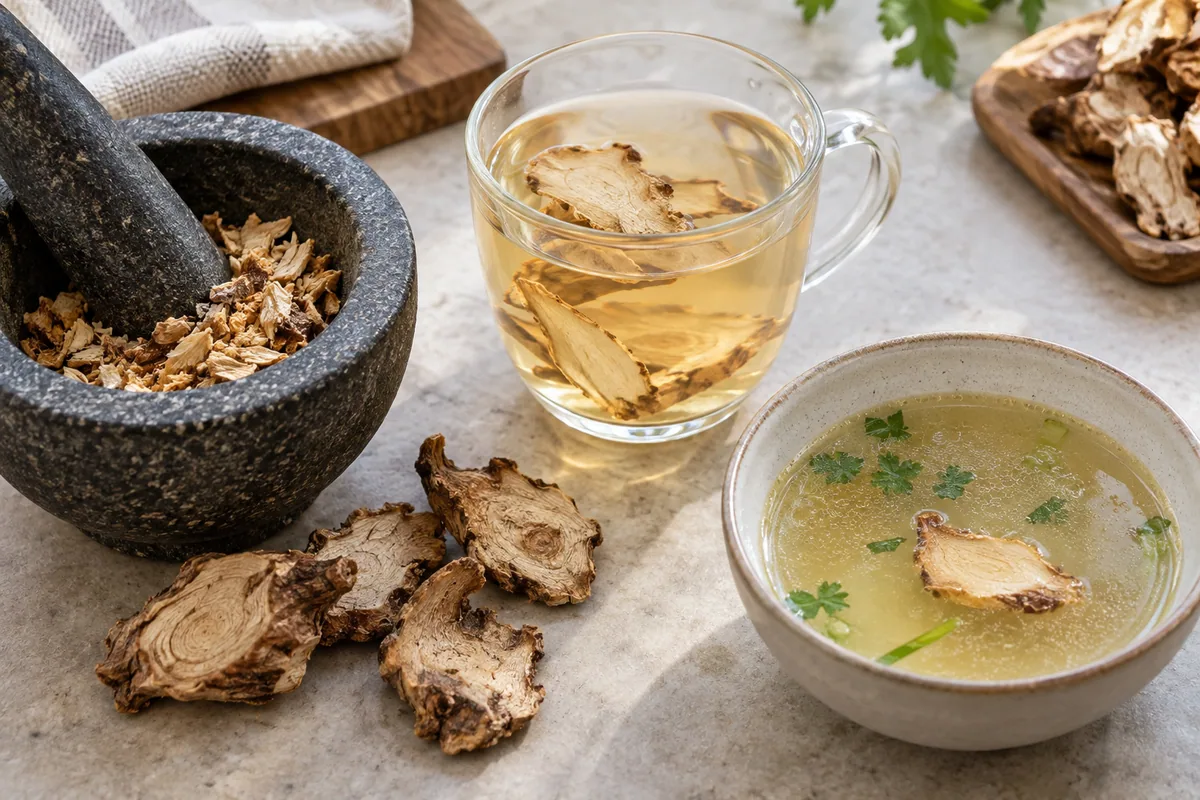
Learning how to use dried galangal begins with one practical fact: dried slices, larger chunks, and ground material release aroma differently. A slice can be simmered and removed. A chunk may need breaking or milling before use. Powder disperses quickly but is harder to strain and exposes more surface area. The correct method depends on the food, equipment, desired flavor, and whether the ingredient should remain visible.
This guide gives practical approaches for broth, soup, infusion, seasoning, paste, marinade, and extraction development. It does not prescribe a medical dose or promise a health outcome. Quantities are intentionally treated as formulation variables because lot strength, cut, moisture, contact time, and recipe size change the result.
1. Confirm the Species and Format Before Use
Begin by confirming that the material is dried Alpinia galanga rhizome, also called greater galangal or lengkuas. The word galangal can refer to more than one botanical species. A recipe or research paper written for Alpinia officinarum or Kaempferia galanga should not be assumed to apply to Alpinia galanga without review.
Next, identify the commercial format. Dried galangal slices have visible cut faces and a relatively high surface area. Whole or chunk material consists of larger dried rhizome pieces and may require size reduction. Ground galangal is already milled, but the particle-size distribution and storage history can affect handling and flavor release.
Inspect the package label, lot identity, condition, odor, and any instructions supplied with the ingredient. Food manufacturers should release the material through their approved receiving and quality system before it enters production. A kitchen user should follow normal food-safety practices and reject material that is wet, moldy, pest-damaged, unusually odorous, or otherwise inconsistent with the expected product.
If you are choosing between formats, read dried galangal slices versus whole and chunk. It explains how cut visibility, milling, fines, packing, and buyer-side processing change the decision.
For the current Lanka formats, review the dried galangal slices product when a visible cut is useful, or the whole and chunk product when suitable buyer-side size reduction is available.
2. Do Not Apply One Universal Fresh-to-Dried Conversion
Fresh galangal contains substantial water, while dried galangal is more concentrated by mass and much firmer. It is tempting to use a simple substitution ratio, but one fixed conversion can be misleading. Drying method, remaining moisture, slice thickness, storage time, and recipe conditions all influence the perceived aroma.
Start with a small side-by-side trial instead. Prepare the established fresh-galangal version and one or more dried-galangal versions under the same conditions. Record the weight, batch size, temperature, contact time, and final sensory result. Adjust the dried quantity or extraction time until the target profile is reached. That result becomes a formula-specific starting point, not a universal ratio.
Remember that texture may matter as much as aroma. A fresh piece can be pounded into a moist paste. A dried slice may remain fibrous after soaking. If the finished product needs a smooth texture, the process may require suitable milling, straining, or a different ingredient format.
For commercial production, repeat the trial with a representative lot before changing the master formula. Agricultural ingredients vary naturally. A controlled incoming specification and retained sample make the conversion more reliable.
3. How to Use Dried Galangal Slices in Broth and Soup
Dried slices are well suited to broth, soup, stock, and sauce when the goal is to extract aroma into a liquid and remove the fibrous material later. Add the slices early enough for the liquid and heat to contact them. Keep them loose or place them in a food-safe infusion bag if easy removal is important. Simmer under the recipe’s normal safe process, then taste at recorded intervals.
Longer contact is not automatically better. The bright aromatic notes may become balanced at one point, while extended extraction can emphasize woody or bitter impressions in some formulas. Set the endpoint by a sensory target rather than by habit. Remove or strain the slices when that target is reached unless the product design intentionally retains them.
If the broth includes fats, acids, strong spices, or roasted ingredients, the galangal may present differently than it does in hot water. Run the test in the real formula. A clear-water infusion is useful for comparing lots, but it does not predict every finished food.
For repeatability, record the slice weight, liquid volume, heating profile, covered or uncovered condition, contact time, and removal step. Those details are more useful than saying “add a few slices.”
4. How to Prepare a Galangal Infusion or Botanical Tea
For a simple infusion, place inspected dried slices in potable hot water, allow controlled contact, and strain before serving or further processing. A gentle steep emphasizes a different balance from an active simmer. Test both methods if the beverage profile is important. Covering the vessel may reduce the loss of volatile aroma, but it can also change the strength, so include that detail in the method.
There is no universal number of slices per cup. Slice thickness, diameter, dryness, storage age, and personal preference vary. Begin with a modest trial, taste the unsweetened infusion, and adjust one variable at a time. If other botanicals are included, test galangal alone first so its contribution is understood.
A beverage called galangal tea remains a food or beverage product; the name does not establish a therapeutic effect. Do not promise that it treats nausea, inflammation, infection, pain, or another condition unless the finished product has the required evidence and regulatory basis. The article on potential galangal benefits and research explains why extract studies do not automatically support claims for an infusion.
Commercial beverage developers should also assess identity, microbiological controls, extraction consistency, filtration, flavor stability, packaging, labeling, and destination rules. A kitchen method is only the first prototype.
5. How to Rehydrate Dried Galangal
Rehydration can soften the surface and make some cutting or blending operations easier, but it does not return dried galangal to its original fresh condition. Place the required amount in potable water under a controlled time and temperature, then use it promptly within the food-safety plan. The water can capture aroma, so decide whether it belongs in the recipe or should be discarded.
Do not soak an entire commercial lot simply because a recipe mentions rehydration. Added water changes handling, microbial risk, paid weight, process flow, and shelf-life assumptions. Rehydrate only the amount required for the defined production step. Use clean equipment and protect the material from cross-contamination.
After soaking, evaluate texture before sending the material to a knife, blender, or mill. A large fibrous piece can still overload equipment designed for softer foods. If a smoother paste is required, a smaller dried cut or professionally milled ingredient may be more practical.
Record the water-to-material basis, contact time, temperature, drain condition, and yield. These data help a manufacturer calculate the true process input and compare rehydrated dried galangal with fresh material.
6. How to Grind Dried Galangal Safely and Consistently
Dried galangal can be hard and fibrous. Use equipment rated for dry spices and for the expected piece size. A small household blender may not safely reduce large whole pieces. Commercial processors should follow the mill manufacturer’s limits, guarding, dust controls, cleaning procedure, and allergen or cross-contact program.
For small culinary trials, begin with slices or smaller pieces rather than forcing a large chunk into unsuitable equipment. Pulse or mill according to the equipment instructions, allow heat to dissipate, and inspect the result. Excessive milling heat can affect aroma and product condition. Wear appropriate protection where dry dust may be generated.
Particle size changes extraction and flavor release. Fine powder has more exposed area and can become noticeable faster, but it may also clump, remain suspended, or create a gritty texture. Coarse material extracts more slowly and may be easier to strain. Define whether the target is a powder, coarse meal, or broken pieces.
For B2B orders, do not assume that “ground” means one mesh. State the particle-size method and acceptable distribution. If Lanka supplies slices or whole and chunk material for buyer-side milling, the buyer should confirm feed size and equipment compatibility before ordering.
7. How to Use Galangal in Spice Blends and Seasonings
Ground dried galangal can contribute a peppery, woody, citrus-like note to dry seasonings. It may support chili, garlic, lemongrass, coriander, cumin, pepper, and other aromatic systems, but the best balance depends on the finished food. Build the blend by weight, not by an inconsistent spoon measure, and keep a coded record of each trial.
Blend a small amount first and evaluate it in the actual application. A dry sniff test can overemphasize certain notes and miss what happens during cooking. Salt, sugar, fat, acidity, heat, and hydration all change perception. Test the seasoning on the intended protein, sauce, snack, soup, or plant-based base.
Check flow and dispersion as well as taste. Fibrous particles can separate from finer ingredients during transport. A broad particle distribution can create variation from the top to the bottom of a batch. Mixing order and carrier ingredients may matter. These are formulation questions rather than defects in the botanical itself.
When the formula is accepted, connect it to a raw-material specification. A change from fine powder to coarse galangal or from one drying profile to another may require revalidation. The dried galangal specification guide provides the fields needed for a repeatable purchase.
8. How to Use Dried Galangal in Pastes and Marinades
Pastes and marinades need both flavor and appropriate texture. Dried slices can be soaked and milled, dry-milled before hydration, or extracted into part of the liquid phase. Each route creates a different result. A coarse fibrous particle may be acceptable in a rustic paste but unsuitable in a smooth sauce.
Build a process sequence. Decide when the galangal is reduced, when water or oil is added, how long the mixture is processed, and whether it is strained. Keep the food below unsafe time and temperature conditions according to the product’s food-safety plan. Do not treat aromatic spices as preservatives unless a validated finished-product system supports that function.
For marinades, evaluate contact with the actual food substrate. Aroma in the liquid does not prove that the final food has the desired flavor after draining and cooking. Compare the cooked result and record the yield. If the product is commercially packed, validate pH, water activity, heat treatment, refrigeration, or other safety controls as applicable.
Galangal’s role should be described as a flavor ingredient unless another function is substantiated. Laboratory antimicrobial activity from a concentrated extract is not permission to reduce established safety hurdles in a sauce or marinade.
9. Using Dried Galangal for Extraction Development
An extraction brief must define more than the plant name. State the species, plant part, dried format, particle size, solvent system, material-to-solvent basis, temperature, time, agitation, filtration, concentration, and intended endpoint. A water infusion, an ethanol extract, a steam-distilled oil, and a proprietary standardized extract are different products.
Surface area affects extraction. Slices may provide a more repeatable starting cut, while whole or chunk material lets the buyer control final reduction immediately before processing. Fine material may extract faster but can complicate filtration. The best choice depends on equipment and the target compounds or sensory profile.
Run a mass balance during pilot work. Record starting material, moisture basis, extract volume, filtered solids, concentration step, and final yield. A quoted percentage is meaningful only when the method and calculation basis are the same. Do not infer a commercial yield from a research paper that used a different solvent, scale, or plant preparation.
Buyers should request a representative raw-material sample and evaluate it in their own process. The supplier can describe the dried ingredient; the extractor must validate the extraction method and final product.
10. How Much Dried Galangal Should You Use?
There is no single correct dose for flavor, and this article does not provide a medical dose. A mild broth, concentrated paste, dry seasoning, and botanical extract have different objectives. The useful amount depends on format, surface area, lot aroma, recipe matrix, contact time, temperature, serving size, and the other ingredients.
Use a controlled range-finding trial. Select a low, middle, and high formulation level that is reasonable for the product developer’s process. Keep every other variable constant. Evaluate aroma, taste, aftertaste, texture, color, and overall balance. Choose the lowest level that reliably reaches the target rather than assuming more is better.
Repeat the selected level with a second preparation and, before commercial launch, with representative production material. If the formulation is sensitive, create an incoming sensory reference or analytical criterion that helps detect meaningful lot variation.
When consumers ask for a health-use amount, the responsible answer is different. A culinary ingredient does not have an established universal therapeutic dose. People who are pregnant, nursing, taking medication, managing a condition, or considering concentrated supplements should consult a qualified health professional rather than relying on a supplier blog.
11. Storage and Food-Safety Practices During Use
Keep dried galangal in clean, closed, correctly identified packaging under dry conditions. Protect it from water, pests, strong odors, direct contamination, and uncontrolled heat. Once a pack is opened, close it promptly and follow the facility’s stock-rotation and shelf-life rules. Do not return unused exposed material to the original lot without a controlled procedure.
A dry spice is not automatically free of microorganisms. Food businesses should manage dried galangal within a hazard analysis appropriate to the product and process. Supplier documents, incoming inspection, sampling, laboratory testing, and validated processing controls play different roles. No single certificate eliminates the need for the buyer’s food-safety system.
Washing dried galangal is not a universal instruction. Rinsing can add moisture, spread contamination, change the extraction result, and invalidate a dry-process assumption. Follow the approved manufacturing method. If a wet step is required, control potable water, equipment hygiene, time, temperature, and immediate downstream processing.
Read the food-safety and quality-control guide and the packing and storage guide before scaling from kitchen use to production.
12. How to Scale a Galangal Recipe for Manufacturing
Scaling is not just multiplying the ingredient weight. Larger vessels heat more slowly, mixing patterns change, extraction surfaces differ, and strainers or filters hold different amounts of material. A process that works in one liter may need a revised contact time or particle size in a production kettle.
Create a pilot protocol with the same critical variables planned for production. Identify the galangal lot, format, weight, batch size, liquid composition, temperature profile, mixing, contact time, removal step, and sensory endpoint. Record loss on filtration and any residue that affects yield.
Set acceptable variation before the first commercial batch. Decide how much change in aroma, particle distribution, or color is tolerable. Connect that decision to the incoming ingredient specification and retained sample. If the formula uses visible slices, include appearance and breakage. If it uses milled material, include particle size and dispersion.
The raw material and the process must work together. Review the sample evaluation workflow before approving a lot. When the requirement is ready, send the format, application, volume, destination, and packing needs through the buyer inquiry page.
Frequently Asked Questions
Should dried galangal slices be removed after cooking?
They are firm and fibrous, so many broth and infusion methods remove or strain them after the target aroma is reached. A finished product may retain visible material by design, but that choice should be tested for texture and consumer use.
Can dried galangal be ground into powder?
Yes, when the equipment is suitable for hard, fibrous dried spices. Define the target particle size, manage dust and heat, and test the powder in the real formula. Do not force large pieces into equipment that is not rated for them.
Do I need to soak dried galangal before use?
Not always. Slices can often go directly into a controlled simmer or steep. Rehydration may help a cutting or blending step, but it changes process and food-safety conditions. Use it only when it serves the method.
Is galangal tea a medicine?
No medical conclusion follows from the name. It is a beverage preparation. Any disease-related claim requires evidence for the finished product and review under the applicable rules.
Can Lanka recommend an exact usage rate?
Lanka can discuss format and sample availability, but the final rate must be established in the buyer’s formulation. Send the recipe context, process, and target sensory profile so the sample can be evaluated on a relevant basis.
Sources and Verification
- Kew Plants of the World Online: Alpinia galanga for accepted botanical identity.
- PubMed Central: aroma-active compounds in greater galangal for analytical and sensory aroma context.
- Codex Alimentarius: Code of Hygienic Practice for Spices and Dried Aromatic Herbs for general hygiene principles across production and use.
- FDA: Label Claims for Conventional Foods and Dietary Supplements for United States claim categories and regulatory context.
This guide provides culinary and food-manufacturing information, not medical advice or a therapeutic dosage. Validate the recipe, process, safety controls, label, and destination compliance for the finished product.
Prepared for buyer education. Product, test, document, availability, price, and destination requirements remain subject to written verification for the relevant order and lot.